

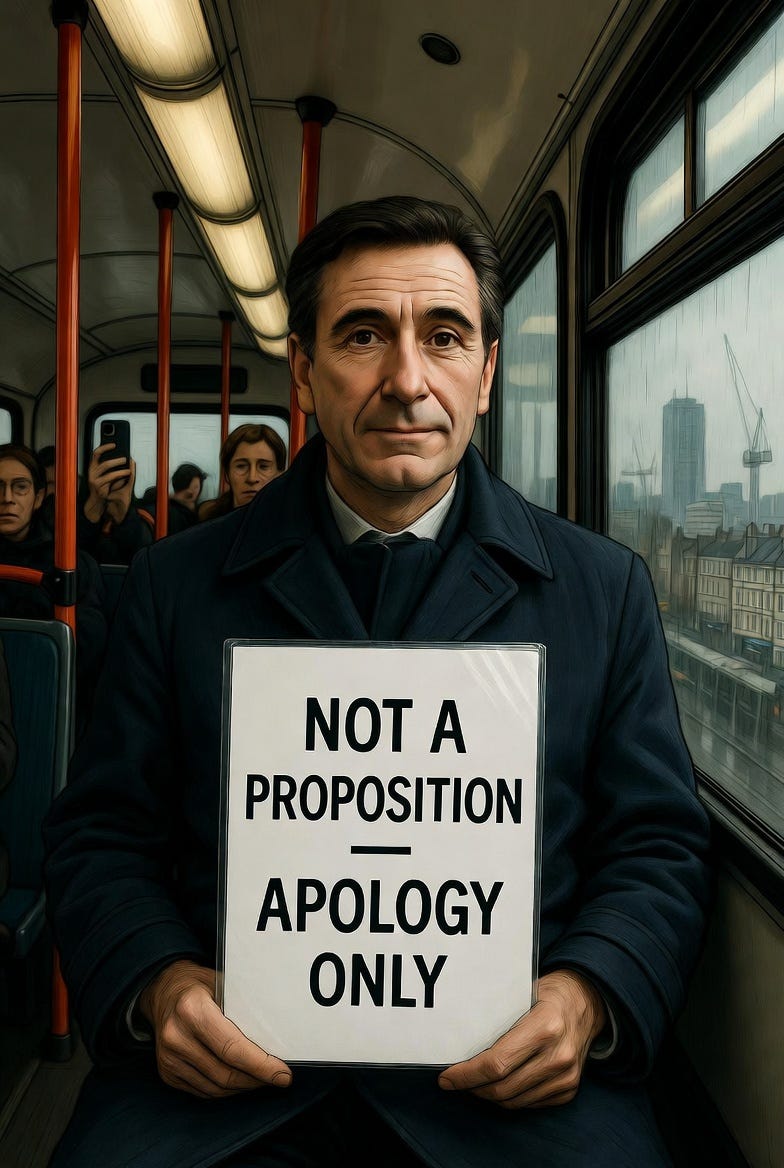
The eye contact lasted approximately one second.
Malcolm Oakes—and it is worth establishing at the outset that Malcolm was not a man who sought connection on public transport, that he had in fact spent thirty-one years perfecting the particular thousand-yard stare of the experienced London commuter, a gaze calibrated to pass through fellow passengers as though they were made of a slightly more interesting grade of air—Malcolm Oakes looked up from his book on the 8.47 number 12 bus and met, briefly and entirely without intention, the eyes of a woman sitting diagonally opposite.
She looked away. He looked away. The bus continued toward Peckham with the lumbering, unhurried certainty of a bus that has seen everything and been impressed by none of it.
That was all.
That was, Malcolm would reflect later—much later, in the specific small hours that exist for the purpose of reviewing one’s failures with maximum clarity and minimum mercy—the entirety of the original incident.
The problem was not the eye contact.
The problem was that in the half-second before he looked away, Malcolm had registered something in the woman’s expression that he interpreted—and he would, in time, come to understand that interpreted was doing significant structural work in this sentence—as discomfort. A fractional tightening. The micro-expression of a person who has been looked at when they would prefer not to have been.
He thought about this on the walk from the bus stop to his office. He thought about it during the eleven o’clock meeting, which concerned quarterly projections and which he had previously found sufficiently absorbing to crowd out most other mental activity. He thought about it at lunch. By three o’clock he had arrived at the conclusion, with the solemn finality of a jury returning a verdict, that he owed the woman an apology.
This was, he recognised, not a rational position. He had looked at a person on a bus. People looked at people on buses. It was, in the broad taxonomy of human behaviour, among the most unremarkable entries. And yet the fractional tightening remained in his memory with the vividness of a thing that mattered, and Malcolm was a man for whom things that mattered required address.
He would apologise. Briefly, sincerely, without drama. He would catch the same bus, encounter the woman—who was presumably a regular, given the hour and the route—offer a simple, clean acknowledgement of the previous day’s inadvertent intrusion, and the matter would be closed.
He had resolved more complicated things than this.
He caught the 8.47 on Thursday.
She was there. Same seat, diagonally opposite, reading something on her phone with the focused attention of a person who has learned to construct a private room in a public space. Malcolm sat down. He waited for the appropriate moment, which he understood to be a moment when she was not reading, not looking out of the window, not in any way productively occupied—a moment of neutral availability, which proved, over the course of the journey to Peckham, not to arise.
At London Bridge she stood up.
Malcolm stood up also, which was not his stop, and said, ‘Excuse me—’
She walked off the bus.
He stood in the doorway of the bus as it prepared to close its doors and watched her cross the road with the purposeful stride of a woman who is not aware she is being watched, which was, Malcolm understood with sudden and terrible clarity, precisely the problem he had been trying to address.
The doors closed.
The bus carried him to Peckham.
He was twenty minutes late for work. He did not explain why. There was no explanation available that he was prepared to offer.
The note was his sister Patricia’s idea, offered during a phone call in which Malcolm had outlined the situation with what he felt was admirable concision and Patricia had responded with the long silence of a woman recalibrating her understanding of her brother’s relationship with proportion.
‘Write her a note,’ Patricia said. ‘Leave it with the driver. If she’s a regular he’ll know her.’
‘Bus drivers don’t—’
‘Ask,’ Patricia said, in the tone she used when she had decided a conversation was over.
He wrote the note on Monday evening. He wrote seven drafts. The first was too long. The second was too short and, on reflection, ambiguous in a way that concerned him. The third struck a tone he could only describe as unexpectedly formal, as though he were lodging a complaint rather than withdrawing one. The fourth was better but contained the word inadvertent twice, which seemed, in a note of this length, excessive. The fifth was good. The sixth was better. The seventh read:
I believe we made accidental eye contact on the 8.47 number 12 bus on Tuesday the 14th. I am aware this may have caused a moment of discomfort and I wanted to offer a straightforward apology. There is no further intention behind this note. Sincerely, Malcolm Oakes.
He read it back. It was, he felt, exactly right. Clear, proportionate, and sufficiently explicit about the absence of further intention to preclude misreading.
He gave it to the driver on Tuesday morning, with a description of the woman and the explanation that he wished to apologise for a minor social discourtesy.
The driver, whose name badge read Terry and whose expression suggested he had not previously been asked to act as a postal intermediary in an apology for eye contact, took the note with the careful neutrality of a man who has learned, in twenty years of bus driving, to accept what the job presents.
Malcolm was at his desk at half past nine when his phone rang.
It was Patricia.
‘Have you seen it?’ she said.
He had not seen it. He looked at it on his computer, because Patricia had sent a link, and then looked at it for some time without speaking.
The photograph showed the upper deck of a number 12 bus. In the foreground, a man—Terry, whose expression in the photograph was that of a person who had made a decision he was already reconsidering—held a piece of paper. On the upper deck, visible through the window, a number of passengers were looking at something below with the attentive interest of people who have been given an unexpected reason to look up from their phones.
The caption read: Bus driver reads apology note aloud to passengers. Reason: eye contact. London, everybody.
It had been shared, at the time of Malcolm’s viewing, four thousand, two hundred and seventeen times.
By lunch it was six thousand.
By the time Malcolm left the office it had acquired the description wholesome, which he felt missed the point considerably, and very British, which he felt did not miss it at all.
He did not take the bus on Wednesday.
He took it on Thursday, because not taking it felt like a concession to a universe that had already extracted more concessions from him than he considered fair, and because the apology remained undelivered, which meant the matter remained open, which meant Malcolm remained in the condition he had been in since the 14th: a man with an outstanding debt to decency, accruing interest.
He had made a sign.
He was aware, as he boarded the bus with the sign held at his side, that the sign represented an escalation. He was aware that escalation was not, in the conventional understanding of apology, the direction one was meant to travel. He was also aware that conventional understanding had not, to date, served him especially well in this matter, and that the sign was at least unambiguous, which was more than could be said for everything else he had attempted.
The sign was A4, printed rather than handwritten for legibility, laminated because it had rained on Tuesday and he was not going to go through all of this with a soggy sign. It read: NOT A PROPOSITION — APOLOGY ONLY.
He sat in his usual seat.
He was photographed eleven times before London Bridge.
The cyclist was a young man in a yellow jacket who had been stopped at the lights on Borough High Street when the bus passed and who had, with the reflexive opportunism of a generation for whom the photographable moment is always already being photographed, raised his phone and captured Malcolm in the upper deck window, sign held level with his chest, expression that of a man who has committed entirely to a course of action and is seeing it through on the basis that there is nothing else to do.
The image circulated under the caption British man at his most British and was described, by a columnist in an online publication Malcolm had not previously encountered, as a perfect and complete portrait of a nation.
Malcolm read this at his desk and felt, beneath the considerable weight of his current situation, a flicker of something that might have been pride and which he immediately suppressed on the grounds that it was not helpful.
Patricia called.
‘You laminated it,’ she said.
‘It was raining on Tuesday.’
There was a pause of the kind that contains a great deal of unsaid material arranged in careful order. ‘Malcolm,’ Patricia said. ‘I want you to consider the possibility that the apology is now larger than the original incident.’
‘The original incident,’ Malcolm said, with the precision of a man who has thought about very little else for two weeks, ‘was one second of inadvertent eye contact that caused a moment of discomfort. The apology is proportionate to the moral weight of the incident, not to its duration.’
‘The apology,’ Patricia said, ‘is on the internet. In multiple countries.’
‘That’s not my fault,’ Malcolm said.
‘Malcolm—’
‘That’s genuinely not my fault,’ Malcolm said, because it wasn’t, and because in a situation that had produced very little he could say with confidence, this was something he could say with confidence, and he intended to hold onto it.
He found her on a Wednesday morning, five weeks after the original incident, not on the bus but at the bus stop, which he had not anticipated and for which he had not prepared, which meant he had no sign, no note, no drafted language—nothing but himself, standing on the pavement in the early November rain, which was the condition in which he had begun this enterprise and which seemed, in some obscure way, appropriate.
She recognised him. He could see this in the precise, fractional adjustment of her expression—not alarm, not irritation, but the specific look of a person who has been following a story and has now unexpectedly encountered one of its principals.
‘You’re the eye contact man,’ she said.
‘Yes,’ Malcolm said. ‘I wanted to apologise. For the eye contact. On the bus. On the fourteenth.’
She looked at him. She had, he noticed, the expression of a person who is trying to locate the correct response in a situation for which no correct response has been prepared.
‘I don’t remember it,’ she said.
Malcolm absorbed this.
‘The eye contact,’ she added, in case he had not understood.
‘No,’ Malcolm said.
‘I’m sorry,’ she said, and then appeared to consider whether apologising to the man who had spent five weeks apologising to her represented a conversational position she wished to occupy.
The bus arrived. They boarded it. They sat, by the geometry of available seats, diagonally opposite one another.
Malcolm looked at his book. She looked at her phone. The bus moved through the wet morning with its customary indifference to the private catastrophes of its passengers.
At London Bridge she stood.
‘For what it’s worth,’ she said, not unkindly, ‘it’s a very good sign. The laminating especially.’
She got off the bus.
Malcolm sat with this for the remainder of the journey. Outside, London performed itself in the rain—grey and vast and magnificently unbothered, full of people who had looked at other people on buses and thought nothing of it, people who moved through the world without the persistent, specific conviction that things left unaddressed would quietly compromise the structural integrity of everything.
He looked out of the window.
He looked, briefly and entirely without intention, at his own reflection.
He looked away.
He did not apologise.
It was, all things considered, progress.
Listen to my song, which is based on this story
There Was No Further Intention
Words & Music by John B. Sullivan © 2026