
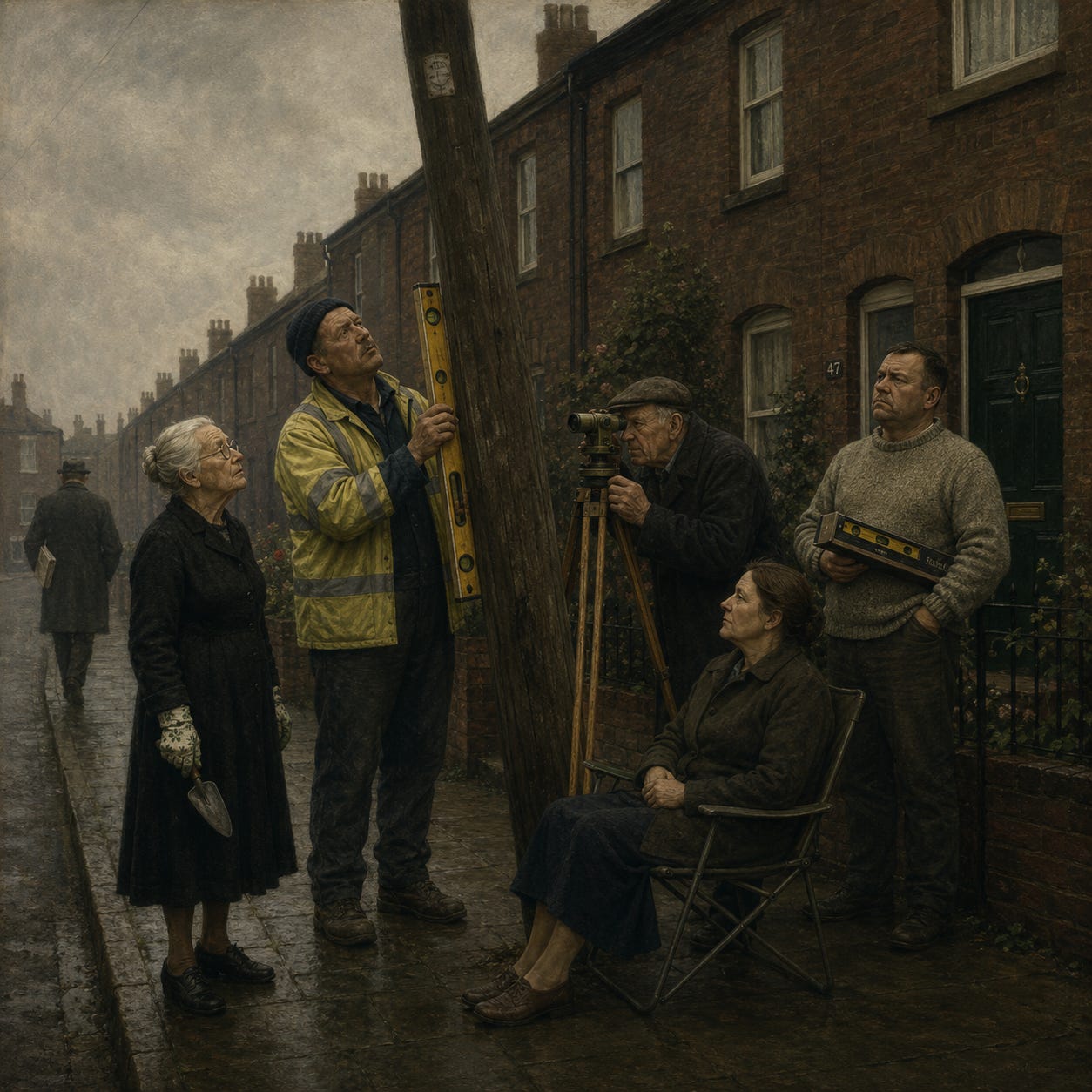
The Lean
The pole had been there since 1961.
Gerald knew this because the pole had a small metal plate near its base with ‘1961’ stamped on it, and Gerald had noticed the plate on the morning of the fourteenth of March, which was a Tuesday, which was the morning he noticed the lean, and he had thought: well, there it is then. Sixty-odd years and nobody’s said a word. He felt, in a mild way, that this reflected poorly on the street.
He stood on the pavement in his good coat—not his best coat, which was for funerals and the occasional wedding, but his good coat, which was for Tuesdays and anything that required a degree of presentability—and he looked at the pole. The pole rose from the pavement outside number fourteen, which was Mrs Fennick’s house, and it carried three wires that went off in different directions toward other poles and ultimately, Gerald supposed, toward the wider world. He had never given the pole any thought before this morning. It had simply been there, the way lamp posts and pillar boxes and other people’s garden walls were simply there, part of the texture of things.
But it was leaning.
Not enormously. Gerald was not a man given to exaggeration—Barbara had said this about him at their wedding, in a speech that had surprised everyone by being about Gerald’s character rather than her feelings, and which had been, in its way, rather good. He was not a man who saw cracks and called them chasms. But the pole was leaning. Perhaps three degrees. Perhaps four. Toward Mrs Fennick’s house, which seemed, when Gerald thought about it, somewhat presumptuous.
He tilted his head. The pole remained leaning.
He straightened his head. The pole did not straighten with it.
He walked on to collect his newspaper.
Mrs Fennick was in her front garden when Gerald came back, doing something to a rose bush that the rose bush did not appear to be enjoying. She was a small, precise woman of seventy-one who had very decided opinions about a great number of things and had been known, on one occasion, to write to the Radio Times about a continuity error in a drama series and to receive, to everyone’s astonishment including her own, a reply.
‘Your telegraph pole is leaning,’ Gerald said.
Mrs Fennick looked up. She had soil on her gardening gloves and a look on her face that suggested the rose bush had been trying her patience since early morning.
‘Which one?’
‘The one outside your house.’
‘I know which one is outside my house, Gerald. I meant which way.’
Gerald considered this. ‘Toward you,’ he said. ‘Toward the house.’
Mrs Fennick pulled off one gardening glove and walked to the gate. She stood beside Gerald and they both looked at the pole together, the way people look at things when they are trying to reach a consensus. The pole rose from the pavement. The wires went off in their various directions. The plate said 1961.
‘Yes,’ said Mrs Fennick.
‘I thought so.’
‘That’s definitely a lean.’
‘I’d say three degrees,’ Gerald said. ‘Perhaps four.’
Mrs Fennick narrowed her eyes. ‘Four,’ she said. ‘Minimum.’
Gerald nodded. He felt the satisfaction of a man whose observation has been confirmed by a reliable source. ‘I expect someone should know,’ he said.
‘I’ll phone the council,’ said Mrs Fennick, in the tone of a woman who has phoned the council before and has no illusions about what this will involve but who understands that the alternative is a leaning pole, which is worse.
‘Good,’ said Gerald. He folded his newspaper under his arm. ‘I’ll leave it with you, then.’
He went home, made a pot of tea, read the paper from front to back including the crossword, which he completed except for seventeen across, which he suspected had a misprint, and then had his lunch, which was a cheese sandwich and an apple, and then watched forty minutes of a programme about canals, which was soothing, and then fell asleep in the chair.
He did not think about the pole again until Thursday.
The council sent a man on Wednesday afternoon.
His name, according to the laminated badge on his high-visibility jacket, was K. Burrows, and he arrived in a white van with the council’s logo on the side and a spirit level on the passenger seat, which suggested either that he had done this before or that he was a man who liked to be prepared. He was perhaps forty, with the look of someone who had explained things to members of the public many times and had developed, in the process, a facial expression that was professionally neutral in the way that a wall is professionally neutral: solid, unremarkable, and not going anywhere.
Mrs Fennick came out immediately. She had been watching from the front window.
K. Burrows placed his spirit level against the pole. The bubble sat in the centre of its little window, serene and unambiguous.
‘Perfectly upright,’ said K. Burrows.
‘That’s wrong,’ said Mrs Fennick.
K. Burrows looked at his spirit level. He looked at Mrs Fennick. He looked at his spirit level again, in the way that people look at things twice when they are certain they are right but have learned that certainty, expressed too quickly, tends to inflame situations.
‘The bubble is centred, madam.’
‘Then your bubble is wrong.’
K. Burrows wrote something in his notebook. Mrs Fennick watched him write it and her expression suggested she would very much like to see what he had written. He closed the notebook.
‘I can assure you—’
‘My neighbour saw it leaning,’ said Mrs Fennick. ‘He’s a very observant man. He noticed a gas leak in 2019 before anyone else on the street.’
This was true, though the gas leak had turned out to be a drain, but the principle stood.
K. Burrows held his spirit level against the pole once more, as though the pole might have changed its mind. The bubble remained centred. He wrote something else in his notebook, got back in his van, and drove away.
Mrs Fennick phoned her son Derek.
Derek arrived on Thursday evening with a spirit level in a cardboard box. He was forty-three, broad across the shoulders, and had the manner of a man who distrusted anything he hadn’t personally verified. He worked in insurance, which had given him a professional interest in things going wrong and a personal interest in proving that they had. He held up the box as he came through the gate.
‘Stabila,’ he said. ‘German. Thirty years ago I bought this and it has never been wrong.’
‘The council man said the pole was straight,’ said Mrs Fennick.
‘The council man,’ said Derek, ‘uses a spirit level that lives on a van seat. I wouldn’t trust that to hang a picture.’
They went out to the pole together. Derek placed his spirit level against it with the care of a man performing a procedure. He looked at the bubble. He adjusted his grip. He looked again.
‘Hm,’ said Derek.
‘What?’
‘It’s leaning,’ he said. ‘But the other way.’
Mrs Fennick stared at him. ‘What do you mean, the other way?’
‘Away from the house. About two degrees. Maybe three.’
‘Gerald said it was leaning toward the house.’
‘Gerald,’ said Derek carefully, ‘is not using a Stabila.’
They stood in silence for a moment, both looking at the pole. The pole stood in the way that poles stand: committed to its position, indifferent to the controversy.
‘Perhaps,’ said Mrs Fennick, ‘it leans in different directions at different times of day.’
Derek opened his mouth and then closed it again, because he was a man who had learned, in forty-three years, that some sentences his mother said were best allowed to pass through the world without being engaged.
It was Mrs Fennick who thought of Raymond Stokes.
Raymond Stokes had retired from the Ordnance Survey in 2003 after thirty-one years and had kept, in his garage at number twenty-seven, a theodolite in a case the size of a small suitcase. He had kept it because it was his, technically—there had been some ambiguity about this at the time of his retirement that Raymond had resolved by putting it in his car—and because he felt that a man who owned a theodolite should not be without one. He had used it twice since 2003: once to settle an argument about the gradient of his driveway and once for reasons he preferred not to go into.
He carried the case to the pole on Friday morning with the expression of a man recalled from retirement for a matter of national importance. He was seventy-seven and walked with a slight list to the left, which he did not mention and which no one mentioned to him, though Derek noticed it and thought several things he kept to himself.
Raymond set up the theodolite with a thoroughness that suggested he had been waiting for this moment. A small audience had gathered: Mrs Fennick, Derek, a woman from number nine whose name no one could remember but who had appeared with a folding chair, and two men from the end of the street who had come to see what was happening and stayed because something clearly was.
Raymond looked through the eyepiece. He made adjustments. He looked again.
‘One point eight degrees,’ he said. ‘Toward the house.’
‘There,’ said Mrs Fennick.
‘My level says away from the house,’ said Derek.
Raymond straightened up and looked at Derek with the expression of a man who has thirty-one years of the Ordnance Survey behind him and does not feel that this is a contest.
‘Your level,’ said Raymond, ‘measures relative to gravity. My instrument measures relative to a fixed horizontal plane established by—’
‘What’s the difference?’ said the woman on the folding chair.
Everyone looked at her. She looked back at them with the equanimity of a woman who had brought a folding chair.
‘It’s,’ Raymond began. ‘It’s—’ He stopped. ‘In practice,’ he said, ‘in this specific instance, the difference is approximately four point eight degrees.’
‘So neither of you knows,’ said the woman.
‘We both know,’ said Raymond. ‘We know different things.’
The woman appeared to find this satisfying in a way that the rest of the group did not.
The photograph appeared online that evening. Derek had not taken it—he was firm on this point when asked later—but someone had, and it showed the pole, the theodolite, Raymond, Derek, Mrs Fennick, the woman on the folding chair, and the two men from the end of the street, all in a composition that looked, in the particular way of photographs taken on phones without any artistic intent, like a Renaissance painting of something minor and inexplicable. The caption read: POLE SCANDAL—RESIDENTS AND EXPERTS CLASH OVER TELEGRAPH POLE ‘LEAN’ IN QUIET STREET.
Forty-seven people shared it by midnight. Most of them lived in the area. Several of them did not but felt strongly anyway.
The local paper sent a journalist called Fiona Marsh, who was twenty-six and had covered, in the previous month, a dispute about a car park, a dispute about a fence, and a dispute about whether a local business constituted a business or a hobby for planning purposes. She arrived on Saturday morning with a notepad and the expression of a woman who understood that the pole was not really about the pole.
She spoke to Mrs Fennick, who said the pole was definitely leaning and had been for years and that someone ought to have noticed sooner.
She spoke to Derek, who said the council’s equipment was inadequate and that he was considering a formal complaint.
She spoke to Raymond, who gave her a seven-minute explanation of the difference between spirit levels and theodolites, which she wrote down in full because she had learned that the things people explained at length were rarely the things the story was about.
She tried to speak to the woman with the folding chair, who was not there on Saturday.
She knocked on Gerald’s door.
Gerald answered in his good coat, because he had been about to go out.
‘I’m writing a piece,’ said Fiona, ‘about the telegraph pole. I understand you were the first to notice the lean?’
Gerald looked at her. He looked past her at the pole. He tilted his head.
‘Was I?’ he said.
‘Mrs Fennick says you mentioned it to her on Tuesday.’
‘Did I?’ Gerald looked at the pole again. It rose from the pavement. The wires went off in their directions. The plate said 1961. ‘I may have said something,’ he said. ‘I honestly can’t remember what the specific—I mean, I walk past it every morning. It’s possible I said something. Is it leaning?’
Fiona looked at the pole. It was, she thought, possible. Or not. It was very hard to say.
‘That’s what everyone’s been—there’s been quite a lot of—’ She stopped. ‘There are two spirit levels and a theodolite involved,’ she said.
‘Good Lord,’ said Gerald, with the mild interest of a man hearing about something that happened in a country he has no plans to visit. ‘What for?’
Fiona wrote something in her notebook. She looked at Gerald, who was looking at the pole with the expression of a man who has genuinely never thought about it and is not sure he intends to start now.
‘Do you think it’s leaning?’ she said.
Gerald considered this with what appeared to be genuine open-mindedness.
‘I think,’ he said, ‘that it’s a telegraph pole. They put them in the ground and they stay there. Sixty-odd years, that one. Since 1961—there’s a plate.’ He nodded at it. ‘I expect if it were going to fall on someone it would have done it by now.’
He said good morning to Fiona, stepped around her, and walked up the street to collect his newspaper.
The piece ran on Wednesday under the headline ‘SPIRIT LEVEL STANDOFF: WHO DO YOU TRUST WITH YOUR TELEGRAPH POLE?’ It was, Fiona felt, not her finest work, but it was accurate. There were quotes from Mrs Fennick, Derek, Raymond, a man from the electricity board who had come on Monday and declared the pole structurally sound, a woman who had emailed the paper to say she had noticed a different pole leaning in a different street and felt this was connected, and a professor of civil engineering from the university who had not seen the pole but had views about poles in general.
There was no quote from Gerald. Fiona had included one—‘I expect if it were going to fall on someone it would have done it by now’—but her editor had cut it on the grounds that it didn’t advance the story.
The pole remained where it had always been.
On Thursday morning, on his way back from the newsagent, Gerald stopped outside number fourteen and looked at it. He stood for perhaps thirty seconds. He tilted his head one way and then the other. A woman walking a dog slowed down and looked at him, and then looked at the pole, and then looked at him again.
‘Is something wrong with it?’ she said.
‘No,’ said Gerald. He straightened up. ‘No, I don’t think so.’ He tucked his paper under his arm. ‘It’s been there since 1961,’ he said, gesturing at the plate, and walked on home.
The woman with the dog stood and looked at the pole for a long time.
It was, she thought, possible. Or not.
She took out her phone.
The Correct Way to Cross a Room
The knee was fine.
Sylvia had known the knee would be fine—her mother had been walking on it for seventy-four years without any notable incident and was not, in Sylvia’s assessment, a woman whose knees gave trouble. It was her mother’s opinions that gave trouble, and her mother’s opinions had no cartilage to wear down and showed no signs of deteriorating with age. But the GP had referred her, and the consultant had confirmed what Sylvia had known since the appointment was made, and now her mother was coming through the swing doors in her good blouse looking both vindicated and faintly disappointed, the way people look when a diagnosis removes the possibility of being interesting.
Sylvia stood up.
And that was when she saw him.
The man—mid-fifties, beige jacket, the expression of someone who had been waiting longer than expected and had made his peace with it—rose from a chair on the far side of the waiting room and crossed to the exit. There was nothing wrong with the man. There was nothing wrong with his jacket or his expression or his evident desire to leave. What was wrong—and Sylvia registered this the way she registered spelling errors in menus, which was immediately and with a faint sense of personal affront—was his route.
He had gone around the outside of the chairs.
The chairs were arranged in three rows of five in the centre of the room, with an aisle down the middle. The exit was diagonally opposite the man’s starting position. He had walked to the right, followed the wall past the window—past it entirely, past the full length of it—turned at the corner, and come back along the other wall to the door. He had, in doing so, covered perhaps four times the necessary distance, passed the window twice, and navigated around a rubber plant that was not, by any reasonable measure, an obstacle.
Sylvia’s mother arrived at her elbow. ‘She says it’s perfectly fine. A bit of—’
‘Did you see that?’ said Sylvia.
‘See what?’
‘That man. The way he crossed the room.’
Her mother looked at the door, which was closing behind the beige jacket. ‘What about him?’
‘He went around the outside,’ Sylvia said. ‘All the way around. When he could have gone straight through the middle. Down the aisle and diagonal to the door.’ She looked at the room. ‘Or even—’ She stopped. ‘Actually, there are at least three better ways.’
Her mother looked at the room. Her mother was a woman called Patricia who had grown up in a house where problems were addressed directly and who had passed this quality to Sylvia along with her cheekbones and a tendency to take things slightly too far.
‘Well,’ said Patricia, looking at the chairs. ‘You’d want to go between the first and second row, wouldn’t you. Not the second and third.’
‘That’s what I thought. But then there’s the question of the diagonal.’
‘The diagonal’s only worth it if you start from the right position.’
‘Exactly.’
They stood side by side looking at the empty waiting room. A woman with a clipboard walked through it without apparent thought, cutting between the first and second rows and angling toward the reception desk in a single fluid movement that was, Sylvia felt, almost certainly accidental but was nonetheless correct.
‘There,’ said Sylvia.
‘Yes,’ said Patricia. ‘Although she had a different destination.’
‘The principle holds.’
Patricia put on her coat. ‘I suppose the question is whether people go around because they don’t see the middle route, or because they see it and prefer the outside for some reason.’
Sylvia had not thought about this. She thought about it now, standing in the middle of the outpatients’ waiting room of the Royal Victoria Hospital while her mother did up her buttons, and it opened up beneath her like a trapdoor.
On the back of the appointment card, she drew a rectangle. She divided it into sections. She drew three lines through it and labelled them A, B, and C.
They were halfway to the car before Patricia said, ‘You’ve still got the pen.’
Martin was in the kitchen when they got back, doing something with a tin opener that suggested the tin opener was not behaving. He was fifty-two, sandy-haired, and possessed of a quality that Sylvia had initially mistaken for patience and had come to understand was more specific than that: he was a man who could sustain interest in small things for a very long time, provided the small things were sufficiently precise. He had spent three weeks one autumn researching the correct way to stack a dishwasher and had arrived at conclusions he still stood by.
‘The knee’s fine,’ said Sylvia, putting her bag on the table.
‘Good,’ said Martin, without looking up from the tin opener.
‘There was a man in the waiting room,’ said Patricia, sitting down and accepting this as her due, ‘who crossed it in completely the wrong way.’
Martin looked up.
Sylvia produced the appointment card. She had refined the diagram in the car, with Patricia holding the card steady at junctions, and it now showed four possible routes, annotated with estimated step counts and a note about the rubber plant. Martin took it and held it the way he held things he was genuinely interested in, which was level and slightly away from him, as though distance improved resolution.
‘He went around the outside,’ Sylvia said. ‘The whole outside. Past the window twice.’
‘Past the window twice,’ Martin repeated. He looked at route D, which Sylvia had added to illustrate the man’s actual path. Route D was a large irregular rectangle that occupied most of the card’s border. It looked, next to routes A, B, and C, faintly tragic.
‘Why?’ said Martin.
‘That’s what I said,’ said Patricia.
‘We don’t know,’ said Sylvia. ‘That’s part of it.’
Martin set the card down on the table and looked at it for a moment. Then he got up, went to the drawer where the good pens were kept, took out a ruler, and sat back down.
‘The diagonal question,’ he said, ‘depends on the chair spacing. How far apart were the rows?’
‘Standard,’ said Sylvia. ‘NHS standard. Wider than you’d like.’
‘Because if the rows are too wide, the diagonal through the middle becomes inefficient compared to a straight aisle route with a single turn.’
Sylvia looked at him. She had been married to this man for twenty-four years and had loved him consistently throughout, but there were moments when he clarified something she had been circling and she felt, briefly, that she was seeing him for the first time.
‘I hadn’t thought about the chair spacing,’ she said.
‘You’d need to go back,’ said Patricia.
‘I’d need to go back,’ Sylvia agreed.
Martin was already drawing.
She went back on Friday, on the pretext of asking about a repeat prescription that could perfectly well have been requested by phone. She took a small notebook and sat in the waiting room for forty minutes. She noted the chair spacing—wider than standard, as it turned out, which Martin had predicted—and the position of the rubber plant, which was further from the window than she had remembered, and the precise location of the exit relative to the rows. She observed eleven people cross the room. Seven went around the outside. Three used the aisle. One sat back down and didn’t cross it at all, which she recorded but felt unable to account for.
She also noted that the aisle, while present, was slightly obstructed at the far end by a leaflet stand that had no business being there.
She came home and revised the diagram.
Martin had, in her absence, measured their own sitting room. He met her in the hall with a tape measure still in his hand and the expression of a man with findings.
‘Our sitting room is almost exactly the same proportions,’ he said. ‘Slightly narrower. I’ve been working out the optimal crossing pattern.’
‘For our sitting room?’
‘As a model. For the principle.’
Sylvia took off her coat. ‘The leaflet stand is the problem,’ she said. ‘It’s blocking the natural exit point of the aisle. Without it, route B becomes clearly optimal. With it—’ She paused. ‘With it, I think route D is almost rational.’
‘Almost,’ said Martin.
‘Almost.’
Martin nodded slowly, with the gravity of a man acknowledging a hard truth about human behaviour. ‘I’ve been thinking about the outside-wallers,’ he said. ‘I think they’re not seeing the room. I think they’re seeing the chairs.’
Sylvia stopped with her coat half-hung. ‘Say that again.’
‘The room has a route through it. The chairs suggest an obstacle. People respond to the chairs rather than the room.’ He looked at her. ‘They’re solving the wrong problem.’
Sylvia hung up her coat very carefully.
‘Martin,’ she said. ‘That’s it.’
She had not intended to tell Deborah next door. Deborah was her closest friend in the way that proximity makes people close—they had shared a fence for eleven years and had graduated from fence-related conversation to actual conversation somewhere around year three, and Deborah was warm and funny and interested in things, which were the qualities Sylvia valued most. She had not intended to tell Deborah because she was aware, in the part of her mind that maintained a watching brief on the rest of it, that the diagram had now been revised four times and that this was perhaps more revisions than the situation strictly required.
But Deborah came around on Saturday morning to return a casserole dish, and the diagram was on the kitchen table, and Deborah picked it up.
‘What’s this?’
Sylvia told her. She had meant to give a brief account. The account was not brief.
Deborah sat down. She looked at the diagram. She turned it around. She turned it back.
‘Can I show this to Geoff?’ she said.
Geoff was Deborah’s partner, a quiet, methodical man who taught secondary school maths and spent his weekends on projects of incremental improvement. He had recently re-tiled their bathroom to tolerances that his own grouting guide described as unnecessary.
‘What would Geoff—’ Sylvia began.
‘He did ergonomics,’ said Deborah. ‘One semester. He never shuts up about it.’
Geoff came over that afternoon. He looked at the diagram for four minutes without speaking, which was either very good or very bad. Then he said, ‘You need to model the decision point.’
‘What decision point?’ said Martin.
‘The moment the person decides which way to go. Because they’re not deciding when they’re halfway across. They’re deciding before they start. So whatever they see from their starting position—that’s your data. Not the route itself. The view.’
There was a silence in the kitchen that had a particular quality, the quality of a silence in which several people are simultaneously realising that a thing they thought they understood is larger than they thought.
‘So we need to know what the room looks like from the chair,’ said Sylvia.
‘From each chair,’ said Geoff. ‘They’re all different starting positions.’
‘There are fifteen chairs,’ said Martin.
‘I know,’ said Geoff. He did not say this as a deterrent. He said it as a man who has just been told the dimensions of a project and is already planning the methodology.
Martin got up and put the kettle on. This was, Sylvia understood, his way of committing to something.
By the time the tea was made, there was a WhatsApp group. Deborah had named it ‘The Room,’ after a brief discussion in which ‘Crossing Patterns’ and ‘The Chair Problem’ had both been proposed and rejected. It had four members. By Sunday evening it had seven, after Geoff mentioned it to a colleague who mentioned it to her husband, who was a retired architect and joined with the message: ‘Been thinking about this for thirty years. Finally.’
The retired architect was called Howard and he did not use punctuation in messages but used it extensively in the two-page document he sent on Monday morning, which was titled ‘Ambulatory Decision-Making in Static Seating Environments’ and which contained, on page two, a hand-drawn diagram that was almost identical to Sylvia’s original appointment card sketch, which she felt was either validating or upsetting and couldn’t decide which.
The practical was Martin’s idea, though he attributed it to Howard to avoid the appearance of escalation. The proposal was simple: they would return to the waiting room, occupy chairs in various positions, and observe both their own instinctive crossing impulse and the routes of actual patients, noting starting positions and apparent decision points.
‘We can’t just sit in a hospital waiting room watching people,’ said Deborah.
‘We’d be sitting in a hospital waiting room,’ said Martin. ‘People do that constantly. It’s almost the defining activity.’
‘We wouldn’t be waiting for anything.’
‘How would anyone know?’
This was, everyone felt, both a reasonable point and a slightly troubling one.
They went on Tuesday: Sylvia, Martin, Geoff, and Howard, who brought a clipboard and a lanyard from a conference he had attended in 2019, which he wore around his neck without explanation. Patricia came because she felt she had a prior claim, having been present at the discovery. She brought her folding travel seat on the grounds that the NHS chairs were too low for her hip, which was fine, and set it up near the rubber plant, which was not ideal from a sightline perspective but which she felt was her spot by rights.
They sat in their various chairs. They waited. People came in and crossed the room.
Howard made marks on his clipboard. Geoff watched the decision point with the focused attention of a man watching a penalty shootout. Martin counted steps. Patricia, from beside the rubber plant, offered a running commentary in a low voice that was not quite low enough, causing a woman with a bandaged wrist to look over twice.
Sylvia watched.
Seven people went around the outside. Two used the aisle. One stood for a long moment, appeared to consider, and then sat back down—the same behaviour she had recorded on her first visit, which she found both baffling and, somehow, the most honest response.
And then a woman in a green coat came through the doors, crossed the room in a clean diagonal from door to reception—not route A, not route B, not any route on any version of the diagram, but a new route, a route that cut the corner of the first row and used the gap between the second and third with a slight pivot, a route so efficient and so apparently unconsidered that Sylvia’s pen stopped moving and she simply watched.
The woman reached the reception desk, gave her name, and sat down in a chair near the window.
She had not looked at the room at all. She had simply crossed it.
Howard was writing furiously. Geoff had his phone out. Martin was mouthing a step count. Patricia had turned around on her folding seat to watch the woman, who was now reading a magazine with the perfect serenity of someone who had no idea she had done anything.
Sylvia looked at her notebook. She looked at the room. She looked at the woman in the green coat.
Something was occurring to her. It was occurring to her slowly, the way things occur to people who are very intelligent and have therefore constructed very thorough explanations for things and must therefore dismantle the explanations carefully, brick by brick, before the new thought can get in.
The woman had not solved the problem. The woman had not seen the problem. The woman had simply wanted to get to the reception desk and had gone there, and the room had accommodated her, the way rooms accommodate people who are not thinking about them.
Sylvia sat with this for a moment.
Then she closed her notebook.
She looked at the diagram—the current version, revision seven, with Howard’s amendments in red and Martin’s step counts in the margin and Geoff’s decision-point annotations in pencil. It was, she thought, a very good diagram. It was thorough and precise and it was the product of genuine thought by several intelligent people and it was, she now understood, a diagram of a problem that the woman in the green coat had not had.
She put the notebook in her bag.
She said nothing, because the others were still working and she respected their process. She sat quietly in her NHS chair, which was too low and slightly uncomfortable, and she watched people cross the room, and she thought about what it meant to see a route versus to simply take one, and whether the seeing was the problem or the solution, and whether there was a difference, and she found that she did not know and that this was, unexpectedly, rather a relief.
On the way out, she crossed the room herself. She did not think about it. She went between the first and second rows, angled slightly toward the door, stepped around the leaflet stand, and was outside in seven steps.
Martin caught up with her in the car park.
‘Route B,’ he said. ‘With the leaflet stand modification. I counted.’
‘Yes,’ said Sylvia.
‘You didn’t look at the room.’
‘No,’ she said. ‘I didn’t.’
Martin considered this. He had the tape measure in his jacket pocket—she could see the outline of it. He was a good man, her husband. A thorough man. A man who understood that some things required measurement and some things only appeared to.
‘Howard wants to do the upstairs waiting room as well,’ he said. ‘Apparently it’s got a different layout. More of an L-shape.’
Sylvia looked at him.
She thought about the woman in the green coat. She thought about seven revisions of a diagram that had started as a rectangle on the back of an appointment card. She thought about her mother saying you’d want to go between the first and second row, wouldn’t you, which had started all of this, and which her mother had said with the easy confidence of a woman who had simply looked at a room and known.
‘All right,’ she said.
Martin looked at her. ‘All right, yes, or all right, you’re humouring me?’
Sylvia got into the car. ‘I haven’t decided yet,’ she said.
She had decided. The WhatsApp group had nine members now, and Howard’s document had a second page, and Geoff had mentioned something about a presentation, and she had absolutely decided.
She looked at Martin through the windscreen as he came around to the driver’s side, tape measure in his pocket, clipboard tucked under his arm, the expression on his face of a man who has spent a weekend on something and feels, on balance, that it has been worthwhile.
She had decided.
She just wasn’t ready to say so.
Not yet.
The L-shaped room, after all, did present a genuinely different set of variables.

