

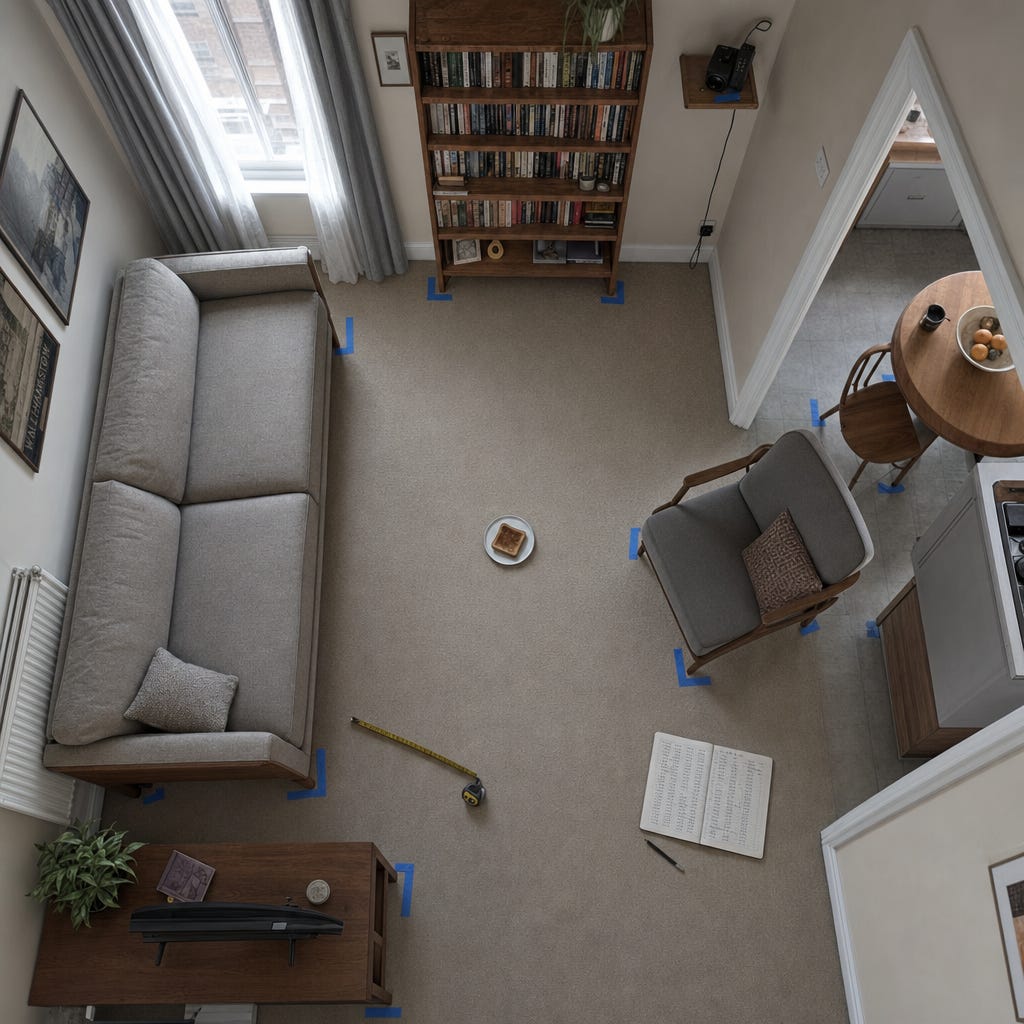
The sofa moved on a Tuesday.
Not dramatically. Not in the manner of sofas in films about houses that should not have been built on ancient burial grounds, or sofas that career across rooms and embed themselves in walls while their owners stand in doorways making the correct facial expressions. This sofa moved four centimetres to the left and then stopped, as though it had somewhere to be and had reconsidered.
Malcolm Pryce noticed because he was a man who noticed things. This was not a gift. It was a disposition, acquired over fifty-three years of paying close attention to a world that had not, on the whole, rewarded close attention with anything other than more things to notice. His ex-wife, Caroline, had called it exhausting. His former employer, a mid-sized logistics firm in Deptford, had called it, initially, an asset, and then, when the notices he served began to concern the managing director’s mileage claims, a liability. Malcolm had called it simply the way things were, which was, he recognised in retrospect, precisely the kind of answer that explained both Caroline and the redundancy. He stood in the doorway of his living room on a Tuesday evening in October with his coat still on and his keys still in his hand and looked at the sofa, which was four centimetres to the left of where he had placed it on Saturday when he had moved it four centimetres to the right to hoover behind it.
He put his keys down.
He put his coat on the hook that was, he was fairly certain, in the correct position.
He went to bed.
On Thursday the kitchen table had rotated.
Not substantially. Six degrees, perhaps seven—Malcolm was estimating, which he found uncomfortable, and resolved to be more precise going forward. The table was a circular table, which he had chosen specifically because circular tables cannot be rotated incorrectly, a piece of reasoning that had seemed, at the time of purchase, entirely sound and that now revealed itself as the kind of reasoning that is sound only in a world where tables do not rotate of their own accord, which Malcolm had, until this week, taken to be all worlds.
He stood beside the table and looked at it. The table offered nothing by way of explanation. This was consistent with its behaviour to date, which had been, prior to Thursday, entirely unremarkable.
He ate his dinner at the rotated table. He could not say it made any practical difference. The table was circular. He was one person. The food was equidistant from him regardless of the table’s orientation, which was, he recognised, precisely the kind of observation that would strike most people as reassuring and struck him as deeply, specifically wrong.
He bought tape on Friday. The narrow kind, blue, used by decorators to mask skirting boards—he had seen it in the hardware shop and it had seemed, in the way that solutions sometimes seem before you have fully examined the problem, exactly right. He applied small strips to the floor at the base of each piece of furniture, marking the original positions with the careful hand of a man who has decided to treat his living room as a crime scene, which was not a thought he allowed himself to complete.
He went to work. He came home.
The sofa was four centimetres to the left of the tape.
The tape was four centimetres to the left of where he had applied it.
Malcolm sat down on the sofa, which was in the wrong place, and looked at the tape, which was also in the wrong place, and understood that he had introduced a variable he could not control into an experiment he had not designed, which was, he was beginning to feel, a reasonable description of his life more generally, though he did not pursue this line of thought because it did not seem immediately productive.
The structural engineer was a man named Bridges, which Malcolm felt was either reassuring or ironic and could not determine which. Bridges walked through the flat with the unhurried authority of a man who has seen everything and found most of it explicable, tapped walls, examined floors, peered at the ceiling with an expression of professional neutrality, and concluded that there was no structural reason for the furniture to move.
‘Furniture doesn’t move,’ Bridges said, in the tone of a man stating a foundational principle of his profession.
‘Mine does,’ Malcolm said.
Bridges looked at him. ‘By how much?’
‘Four centimetres. Roughly. Sometimes a rotation.’
Bridges wrote something in his notebook. Malcolm could not see what. He suspected it was not technical. There was a pause of the kind that contains a conclusion the other person has decided not to share, and then Bridges said he knew a colleague — a second opinion might be useful, in cases such as these.
Malcolm asked what cases such as these were.
Bridges said he would have his colleague telephone.
The second structural engineer — recommended by the first, which Malcolm chose to read as collegial rather than retaliatory — arrived the following week, walked through the flat, tapped the same walls, peered at the same ceiling, and agreed with the first engineer’s findings, which were that there were no findings, and charged one hundred and forty pounds for this agreement, which Malcolm paid because the alternative was not paying it, and the alternative did not seem to advance matters. The second engineer also mentioned a colleague. Malcolm said he did not think a third engineer would find anything the first two had not. The second engineer said that was probably right but that his colleague dealt more specifically with anomalous cases. Malcolm asked what made a case anomalous. The second engineer looked at the notebook Malcolm was holding and said he thought Malcolm probably knew.
The colleague did not telephone. Malcolm was not surprised. He was coming to understand that the function of experts, in situations such as his, was not to provide answers but to produce, at controlled intervals, the suggestion that another expert might. It was a system designed to keep a man moving forward through a corridor that had no end, which Malcolm recognised as a precise structural description of several other things in his life, including his marriage and his career, though he did not pursue this observation because dwelling on it seemed unlikely to constitute progress.
He set up the camera on a Wednesday. It was a small device, motion-activated, purchased online for thirty-eight pounds from a company whose customer reviews were divided between people who had used it to monitor foxes and people who had used it to monitor spouses, two categories of surveillance that Malcolm felt, reading the reviews at midnight, probably overlapped more than either party would wish to acknowledge.
He positioned it in the corner of the living room with a clear sightline to the sofa, the bookshelf, and the kitchen table, which was visible through the doorway. He went to bed. He went to work. He came home.
The sofa had moved.
He reviewed the footage.
The footage showed his living room, still and empty, for nine hours and forty minutes, lit by the ambient orange of the street lamp through the curtains, which gave it the quality of a painting of a living room rather than an actual living room, a painting in which nothing happened and the artist had made no effort to disguise this. Then it showed Malcolm arriving home, opening the door, standing in the doorway, and looking at the sofa.
The sofa, in the footage, was in the correct position.
Malcolm watched this for a moment.
He looked at the sofa, which was not in the correct position.
He looked at the footage, in which the sofa was in the correct position.
He looked at the camera.
The camera was three centimetres to the left of where he had placed it.
He sat down on the floor.
He watched the footage seventeen more times. On the fourteenth viewing he noticed that the curtains were hanging at a marginally different angle than he remembered, which might have been the light or might have been the curtains, and he decided not to pursue this because he had enough on the list of things he could not explain and adding curtains felt like a capitulation. On the seventeenth viewing he noticed nothing new but watched it anyway, in the way that a man will read the same paragraph repeatedly not because he has failed to understand it but because he is hoping that understanding it differently might become available if he persists.
It did not become available.
He called his sister Janet on a Sunday. Janet lived in Guildford and had opinions about most things, which Malcolm had spent a lifetime finding exhausting and now found, unexpectedly, comforting — there was something stabilising about a person who believed the world was fully explicable and that she was the person to explain it. Caroline had believed the world was explicable too, but had concluded, somewhere around the fourth year of the marriage, that Malcolm was the part that didn’t explain. Janet had no such ambivalence. To Janet, Malcolm was simply a man who needed managing, and she managed him with the brisk efficiency of someone who has reclassified a complicated feeling as a logistical problem.
‘Have you tried moving it back?’ Janet said.
‘Yes,’ Malcolm said.
‘And?’
‘It moves again.’
There was a pause. ‘Have you considered,’ Janet said, with the careful enunciation of someone selecting words for a person of limited comprehension, ‘that you might be moving it yourself? In your sleep, or—’
‘The camera—’
‘The camera moved, Malcolm, you said so yourself. Which means you moved the camera. In your sleep. Which is the same point.’
Malcolm considered this. ‘I live on the third floor,’ he said. ‘The sofa weighs—’
‘Sleepwalking is very common,’ Janet said, in the tone of someone for whom sleepwalking explains a great deal about her brother. ‘I’ll send you an article.’
She sent him three articles. He read them. None of them described a case in which a sleepwalker had moved a sofa four centimetres to the left and a kitchen table six degrees clockwise and then returned to bed without waking, though he supposed this was the kind of thing that would be difficult to verify, which was, he was coming to understand, the defining characteristic of his situation: it existed precisely at the threshold of verifiability, in the narrow, maddening corridor between this is definitely happening and I cannot prove this is happening, a corridor Malcolm had not previously known existed and in which he now appeared to have taken up permanent residence.
He rang Janet back to say as much. She said the corridor sounded like anxiety and that she would send him something about that too. He said it wasn’t anxiety, it was epistemology. She said those were often the same thing, which was, Malcolm reflected afterwards, the most philosophically precise thing Janet had ever said and almost certainly the least intentional.
He tried, in the fifth week, simply not measuring.
This lasted two days. On the third day he came home to find the bookshelf had moved and stood in front of it for eleven minutes making no attempt to quantify the displacement, which he felt was a form of acceptance and which was, in practice, significantly worse than measuring, because measuring at least produced a number, and a number, however unwelcome, was a fact, and a fact was something to stand on, and Malcolm was running short of things to stand on.
He measured. Four centimetres. He wrote it in the notebook he had begun keeping, which now ran to thirty-one pages and which he recognised, looking at it from a slight distance, as a document that would concern a reasonable person. He was a reasonable person. He was concerned.
It occurred to him, on a Wednesday evening in November, sitting in his coat on the sofa with the notebook open on his knee, that this was what the preceding fifty-three years had been preparation for. Not the furniture specifically. The condition. The state of having noticed something true that could not be confirmed, could not be shared, could not be resolved, and could not be unfound. Caroline had said, near the end, that living with him was like living with someone who was always just about to say something. Malcolm had not understood this at the time. He was beginning to understand it now. The furniture had been moving all along, he suspected. In everything. Everywhere. He had simply, finally, become the kind of person who looked.
On a Sunday morning in December he moved to the floor.
Not permanently — he retained this caveat, felt it was important — but for the purposes of breakfast, which he ate sitting cross-legged in the exact centre of the living room, equidistant from all the furniture, a position he had calculated with the measuring tape and which meant that any movement of any item would move it neither toward him nor away from him but simply laterally, which felt, if not like safety, then like a defensible position.
The flat was quiet. The winter light came through the curtains at the angle winter light comes through curtains when it has given up on the idea of warmth and is simply going through the motions. Malcolm ate his toast and looked at his furniture, which sat around him at its various incorrect distances with the absolute, unhurried composure of things that have no idea they are doing anything wrong.
He noticed, as he reached for his mug, that the toast was slightly further from his left hand than he had placed it.
He looked at it.
The toast offered nothing. This was consistent with the behaviour of the toast, and of the sofa, and of the table, and of the camera, and of the two structural engineers, and of the universe, which had been, in Malcolm’s experience, consistently and comprehensively uninterested in providing explanations for the things it did.
He picked up the toast.
He ate it.
Outside, the city went about its business with the magnificent indifference of cities, full of people sitting on sofas that were, as far as they knew, exactly where they had left them — people who had never measured, never taped, never watched nine hours and forty minutes of footage showing nothing, people for whom the furniture simply stayed where furniture was put, as it did, as it always had, as it presumably would continue to do for everyone except Malcolm Pryce, fifty-three, third floor, Lewisham, for whom the physical world had decided — quietly, incrementally, for no reason it was prepared to share — to be slightly, persistently, and apparently permanently elsewhere. He did not think he was uniquely afflicted. He thought he was simply the one who had noticed. He was not sure, at this point, which was worse.
He finished the toast.
He remained on the floor.
It seemed, on balance, the most honest place to be.