

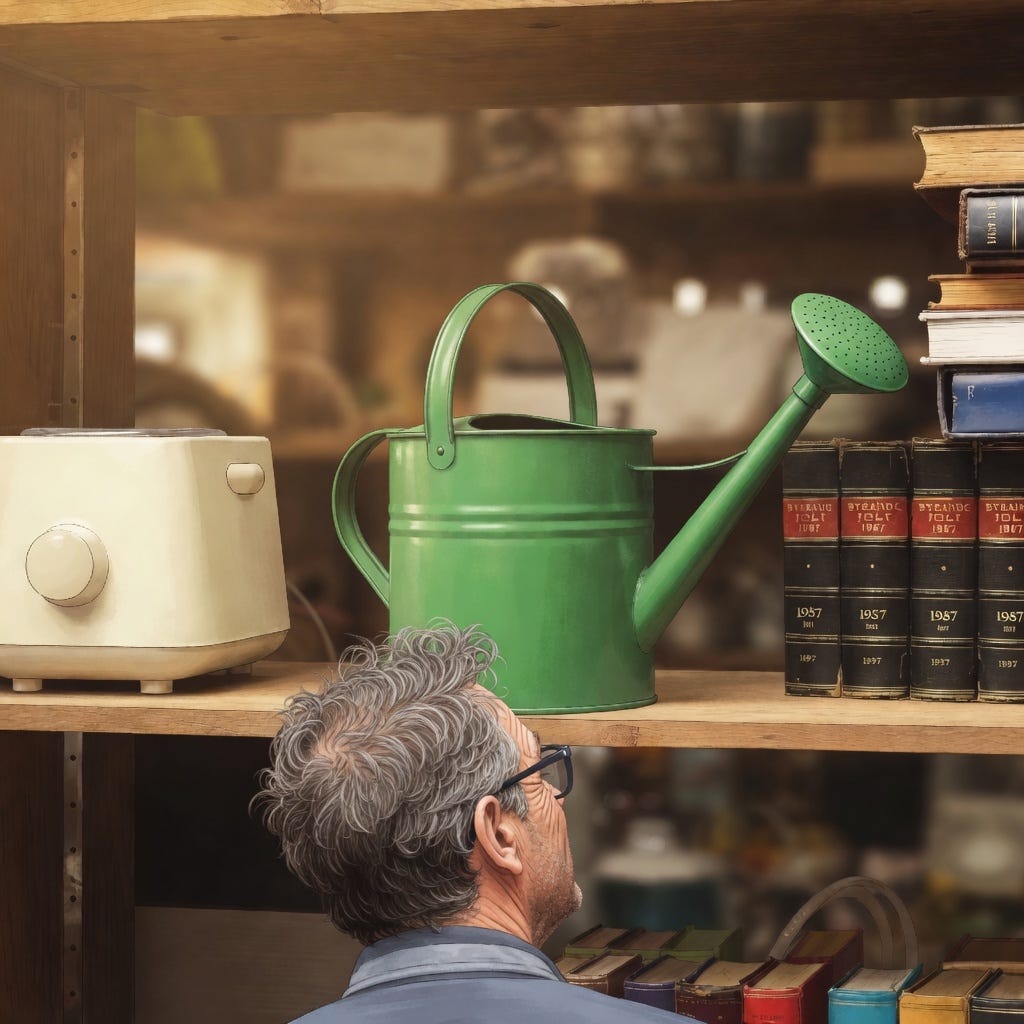
Bernard had wanted a watering can for three years.
Not needed. Wanted. He was precise about this distinction in the way he was precise about very few things, and the precision mattered to him because he lived in a second-floor flat above a dry-cleaner’s in Atherwick and had no garden, no balcony, no window box, no houseplants, and no immediate prospect of acquiring any of these things. He had a spider plant on the kitchen windowsill that had come with the flat and which he watered from a mug, and which had survived six years of this arrangement with the stoic adaptability of something that has decided not to have expectations.
The want had begun on a Saturday morning in the Oxfam on the high street, when he had seen a watering can on the shelf between a bread maker and a set of encyclopaedias from 1987, and had felt—there was no better word for it—a pull. It was green, long-spouted, with a rose attachment that distributed water in a fine arc, and it was perfect. It was the Platonic ideal of a watering can. It was, he understood immediately, exactly the object his life had been organised around not containing.
He had not bought it. He had stood in front of it for four minutes and then walked out and gone home and made coffee and thought about it for the rest of the afternoon.
He thought about it on and off for three years.
The thing was, Bernard had a system.
The system was not written down and had never been articulated to another person, because the other people in Bernard’s life—his colleague Fran, his brother Keith, the man at the corner shop whose name he had never quite caught but who knew Bernard’s coffee order and this felt like enough—were not people to whom you articulated systems of this kind without a great deal of preliminary work that Bernard had never got around to doing.
The system was this: Bernard did not buy things he did not need unless they were books, and he did not buy books unless they were about things he did not already know about, and he did not pursue things he did not have a practical reason to pursue, and he did not—
He wanted a watering can.
He had no garden.
The system was clear.
He went to the Oxfam every Saturday morning anyway, because the Oxfam was between the corner shop and the bakery and his Saturday morning route was the corner shop, then the Oxfam, then the bakery, then home, and this route had been established for so long that deviating from it felt less like a choice and more like a geological event. He would browse the shelves for twenty minutes, buy whatever book presented itself—last week, The History of the Runcible Spoon, which had been more interesting than the title suggested—and leave.
The green watering can was never there again.
Someone had bought it. Bernard felt about this the way you feel about a person you saw once on a train and thought about afterwards—not grief, exactly, but the specific mild ache of an alternative that had closed.
He looked at other watering cans. He looked at them in garden centres, which he visited with no purpose other than to look at watering cans, an activity he conducted with the focused neutrality of a man who is absolutely not going to buy a watering can and is simply maintaining awareness of the market. He had views now. He preferred the long-spouted variety. He was suspicious of plastic. He felt that a watering can should have some weight to it, should feel, when held, like an object that understood its own purpose.
He had, on his phone, seventeen photographs of watering cans.
He had told no one about the photographs.
He met Claire at an evening class.
The evening class was on the history of Byzantine coinage, which Bernard had enrolled in because he had read a book about it—found in the Oxfam, naturally—and had found that Byzantine coinage was one of those subjects that appeared, from the outside, to be very small and turned out, from the inside, to be enormous, the way certain doors open into rooms much larger than the corridor suggested. He had not expected anyone else to be there. He had expected, if he was honest, to be alone with the tutor in a room that smelled of floor polish, which would have been fine.
There were eleven people.
Claire was sitting two seats along from Bernard, with a notebook open and a pen in her hand, and she had the expression of a person who was there because they genuinely wanted to be there, which Bernard recognised because he wore it himself and had learned to identify it in others as a mark of reliability.
She had dark hair going grey at the temples and the kind of attentiveness in her face that suggested she listened to things properly rather than waiting for her turn to speak. She was perhaps fifty, perhaps less. She was wearing a jacket with a small enamel pin on the lapel that was, Bernard noticed—he noticed these things—a reproduction of a Byzantine solidus. He stared at it for a moment longer than was quite polite and then looked at his own notebook.
After the class, in the car park, she said: ‘You kept looking at my pin.’
‘It’s a solidus,’ said Bernard. ‘Justinian I, I think. The reverse with the angel.’
She looked at him. ‘Most people think it’s a Roman coin.’
‘Most people haven’t read Grierson’s Byzantine Coinage,’ said Bernard.
‘Have you?’
‘Twice,’ he said. ‘The second time more slowly.’
She looked at him for a moment with the assessing look of a person recalibrating. ‘I’m Claire,’ she said.
‘Bernard,’ said Bernard.
They walked to the road together and stood at the junction where their routes diverged, and Bernard thought about the watering can—not because it was relevant, but because he was nervous, and when he was nervous his mind went to the watering can the way a tongue goes to a loose tooth, automatically and without useful purpose—and he said, before he could apply his system to the question: ‘There’s a bakery on Atherwick high street that does very good coffee. On Saturday mornings.’ He paused. ‘I go there every week. After the Oxfam.’
‘What do you do in the Oxfam?’ said Claire.
‘Buy books,’ said Bernard. ‘About things I don’t know about yet.’
She looked at him with the expression she would come to deploy regularly—not exasperation, not quite, but the expression of a woman standing at the edge of a thing and deciding whether to find it charming or maddening, and landing, each time, just on the charming side.
‘All right,’ she said. ‘Saturday.’
He cleaned the flat on Friday evening with a thoroughness that the flat had not recently experienced, and which the spider plant appeared to observe from the windowsill with something approaching surprise. He watered it from the mug. He looked at it for a moment.
‘Don’t,’ he said.
The spider plant said nothing, which was the spider plant’s consistent position on everything and which Bernard respected.
He looked around the flat. It was a good flat, in the way that things are good when they have been lived in by one person for long enough to become an accurate expression of that person. There were books on every available surface, organised not alphabetically—that was the system of a person who wanted to find books—but by the order in which he’d read them, so that the shelves were a kind of autobiography, each book sitting next to the book he’d been reading when he read it, which meant that The History of the Runcible Spoon was currently next to a biography of Shackleton and a short study of the migratory patterns of the swift, which was accurate.
There was, on the kitchen worktop, a space.
Bernard looked at the space. It was between the kettle and the bread bin, approximately the width and depth of—
He looked away.
He went to bed and read forty pages of a book about the acoustic properties of medieval bell towers, which was genuinely fascinating, and fell asleep.
Claire arrived at the Oxfam at ten past ten on Saturday, which was after Bernard had already been there for fifteen minutes and had found, on the shelf between a Delia Smith and a car manual, a book called The Taxonomy of Freshwater Molluscs of the British Isles which was either going to be wonderful or very dull and he genuinely could not tell which, and had decided to buy it on the grounds that the uncertainty was itself interesting.
She looked at the book. She looked at him.
‘Freshwater molluscs,’ she said.
‘I don’t know anything about them,’ said Bernard.
‘Is that the criterion?’
‘One of them.’
She looked along the shelves with the interested look of a person encountering a system they haven’t seen before and are deciding whether it has merit. She picked up a book on the history of wallpaper and turned it over and read the back. She put it down. She picked up a book on the mathematics of origami and read the back. She put it in the crook of her arm.
Bernard looked at her.
‘I don’t know anything about it,’ she said, without looking at him.
He felt something that was warm and specific and which he did not immediately have a word for. He found the word later, walking to the bakery—it was recognition. The feeling of recognising something you hadn’t known you were looking for.
They were at the till when Claire stopped.
She was looking at the shelf behind the till where the larger items were kept—a lamp, a small rowing trophy, a cafetière—and on the end of the shelf, long-spouted, green, with a rose attachment, was a watering can.
Not the same one. A different one. But the same kind—the same weight and purpose and self-knowledge, the same sense of being an object that had decided what it was.
‘That’s a good watering can,’ said Claire.
Bernard looked at it.
‘Do you garden?’ said the woman at the till, reaching for it.
‘No,’ said Bernard.
‘It’s four pounds,’ said the woman.
Bernard looked at the watering can. He looked at Claire, who was looking at the watering can with the expression of a person who finds it entirely natural to admire a watering can and has not yet arrived at the question of why a man with no garden would want one.
He thought about his system.
He thought about the space on the kitchen worktop between the kettle and the bread bin.
He thought about the spider plant, which he watered from a mug, and which deserved better, and which had never once complained, and which he had been meaning to do something about for six years without doing anything about it, and which was, when he thought about it—when he really thought about it—a garden. A very small one. A garden of one. But a garden nonetheless, in the sense that it was a living thing that he tended, that depended on him, that was, in whatever way a spider plant could be said to be anything, his.
‘I’ll take it,’ said Bernard.
They had coffee at the bakery and talked for two hours, which was the longest Bernard had talked to anyone since a conversation at a conference about the geology of the Pennines that had gone on until the bar closed. They talked about Byzantine coinage and freshwater molluscs and the mathematics of origami and the acoustic properties of medieval bell towers, which Claire had not read about but had views on, and they talked about the Oxfam and Saturday mornings and the specific pleasure of not knowing things yet, which they both understood in the same way, which was the way of people for whom not knowing is not a deficit but a beginning.
Walking home, Bernard carried the watering can in a paper bag.
It was heavier than he’d expected. Not unpleasantly—it was the weight of an object that knew what it was for, and he carried it with the care you give to things that have been waited for.
He filled it at the kitchen sink when he got home. He stood for a moment with it full, feeling the weight of it shift and settle. He carried it to the windowsill.
He watered the spider plant.
The water came through the rose in a fine arc, soft and distributed, and the spider plant received it with the stillness of a thing being given something it had always deserved and had long since stopped expecting.
Bernard stood back and looked at the watering can on the worktop, in the space between the kettle and the bread bin, where it sat with the completeness of a thing that has arrived at its correct location.
He looked at the spider plant.
He took out his phone and looked at the seventeen photographs of watering cans, and deleted them, because he no longer needed them, and this felt significant in a way he couldn’t entirely explain and didn’t need to.
Claire had said, outside the bakery: Same time next week?
He had said yes.
He made tea and sat in his chair and opened The Taxonomy of Freshwater Molluscs of the British Isles, which turned out, by page four, to be wonderful.
The spider plant stood on the windowsill in the afternoon light, and the watering can stood on the windowsill, and the flat held everything quietly the way it always had, except that it was, Bernard thought—in the way you think things when you’re not quite thinking them, when they arrive sideways while you’re reading about molluscs—it was slightly more itself than it had been this morning.
He read on.
Outside, Atherwick went about its Saturday, and the dry-cleaner’s below him breathed its particular chemical warmth into the afternoon, and somewhere across the town Claire was reading about origami, probably, and the light moved across the room and the spider plant stood in it and the watering can waited, full of purpose, for the next time it would be needed.
Which would be Thursday, Bernard decided.
He would water it again on Thursday.
He had a system.