

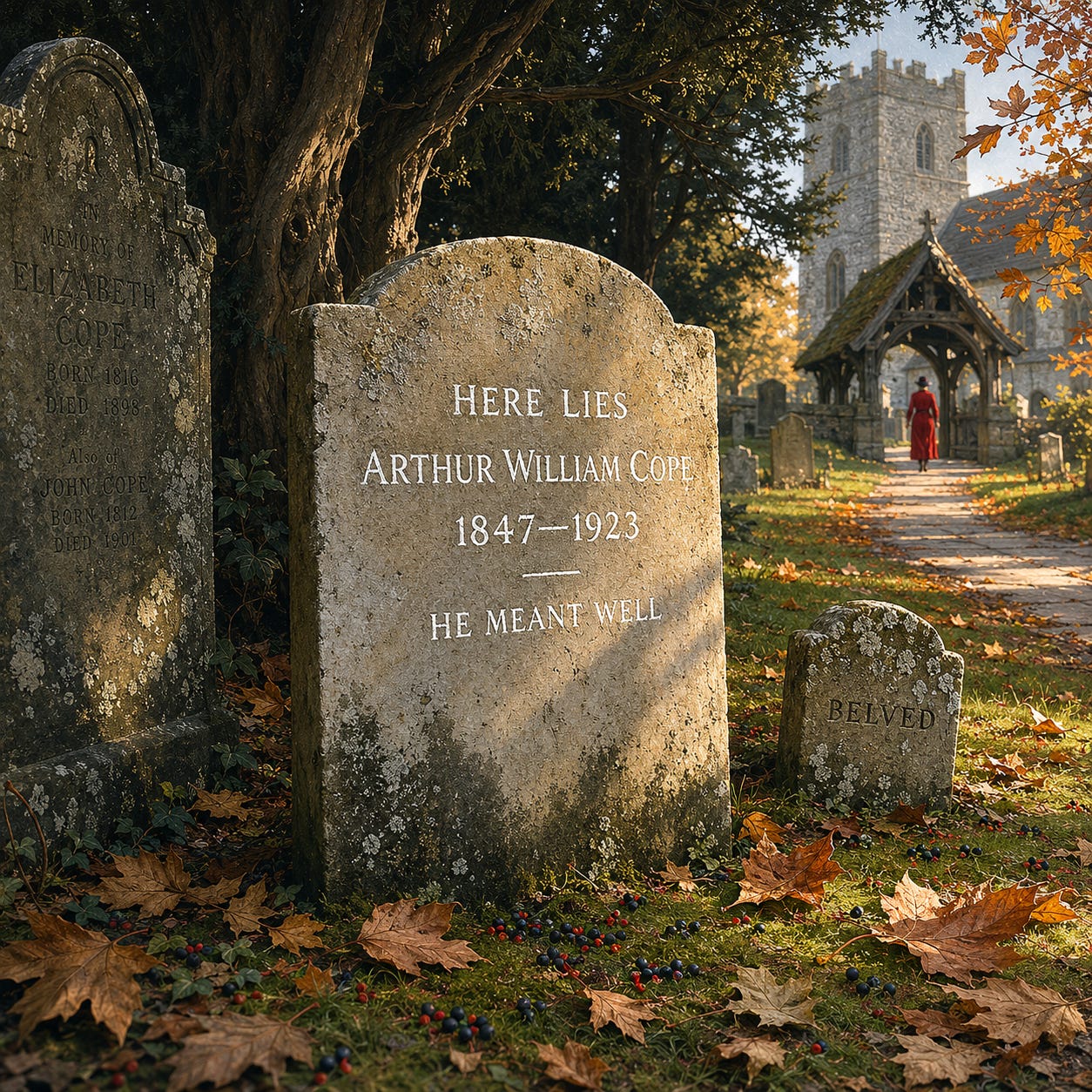
The gravestone had not been there on Thursday.
Reverend Miles Padgett was certain of this, in the way he was certain of very few things—theology having taught him that certainty was the beginning of error and a good breakfast the beginning of wisdom—because he had walked that particular path through St Cuthbert’s churchyard on Thursday morning to retrieve a kneeler that Mrs Holroyd had left outside after the Wednesday evening prayer group, and he had not seen a gravestone, and he was a man who noticed gravestones. It was, in the circumstances of his profession, more or less required.
But here it was. Saturday morning, eight-fifteen, the dew still on the grass and the light coming through the yew trees in the long flat way it came in October, and here was a gravestone that had not been here on Thursday, standing in the south corner of the churchyard between old Walter Fitch—1891 to 1962, Beloved Husband and Father, At Rest—and the low stone of a child named Emmeline Bryce who had lived for four years in 1887 and whose stone always made Miles feel that the universe owed everyone an explanation.
He stood in front of it.
It was not a new stone. That was the first thing. It was weathered limestone, the lettering worn but legible, the base darkened with the particular blackish-green of a stone that had been in contact with damp earth for a considerable time. Someone had cleaned it recently—he could see the marks of a brush on the lower half, and the lettering had been picked out with what appeared to be chalk, which was either an act of care or an act of emphasis, and he wasn’t sure which.
The lettering said:
HERE LIES
ARTHUR WILLIAM COPE
1847—1923
HE MEANT WELL
Miles read this twice. He read He Meant Well with the attention of a man for whom words on stones were not decorative but definitive, the last public statement a life would make. He Meant Well. He had seen At Peace, With The Angels, In God’s Keeping, Sadly Missed, Forever In Our Hearts, and once, memorably, He Did His Best, which had seemed at the time the most honest epitaph he’d encountered.
He Meant Well was something else.
He Meant Well was, depending on how you read it, either the most generous thing you could say about a person or the most devastating.
Miles took out his phone and photographed the stone. Then he looked at his photograph and looked at the stone and put his phone away and stood for a moment in the October morning with his hands in the pockets of his coat and thought about Arthur William Cope, who had meant well, and who was apparently buried in a corner of St Cuthbert’s churchyard in which, as far as Miles’s records went, no one by that name had ever been buried.
He went inside to check the records.
The records did not contain Arthur William Cope.
He made tea and looked out of the vestry window at the corner of the churchyard where the stone stood, visible from this angle as a pale vertical shape between the yew and Walter Fitch, and drank his tea and thought that there were several possible explanations and that none of them were straightforward, which was, in his experience, the defining characteristic of possible explanations.
His phone rang. It was Janet Holroyd.
‘Have you seen it?’ said Janet.
‘The stone,’ said Miles. ‘Yes.’
‘I’m standing in front of it,’ said Janet. There was a pause. ‘He Meant Well,’ she said, in the tone of a woman reading a verdict. ‘Poor man.’
‘We don’t know that it’s—’
‘It’s not in the records?’
‘No.’
‘I didn’t think it would be.’ Another pause. ‘I’ve already phoned the diocese.’
Miles closed his eyes briefly. Janet Holroyd was the chair of the St Cuthbert’s parish council and had been for eleven years, a tenure she maintained through a combination of organisational capability and the simple fact that no one else wanted to do it. She was sixty-three, efficient, and had a relationship with the diocese that Miles privately characterised as armed neutrality. The diocese phoning back was going to take at least a week. The diocese phoning back about a gravestone of uncertain provenance was going to take longer.
‘I don’t think we need to involve the—’ he began.
‘I’ve also phoned Colin Reeve,’ said Janet.
Colin Reeve was the verger, a man of fifty-eight who took the physical fabric of St Cuthbert’s with a seriousness that occasionally tipped into the proprietary. He had once asked a visiting bishop to wipe his feet.
‘Right,’ said Miles.
‘And I’ve left a message for the bishop’s office.’
Miles looked at his tea. ‘Janet,’ he said carefully, ‘it’s a gravestone. It’s a very old gravestone. It isn’t harming anyone.’
‘It appeared overnight,’ said Janet. ‘In a churchyard. Without authorisation.’
‘Most of the people in this churchyard arrived without much authorisation,’ Miles said, and immediately regretted it.
There was a silence of the kind that Janet Holroyd deployed as punctuation.
‘I’ll be there in twenty minutes,’ she said.
Colin Reeve arrived first, in his car, which he parked on the verge in a way that suggested urgency. He was a compact, precise man who wore his verger’s role like a second skin—or perhaps a first skin, Miles sometimes thought, the verger being more essentially Colin than whatever Colin was underneath. He stood in front of the stone with his arms folded, which was his posture for situations requiring assessment.
‘It’s been moved,’ said Colin.
‘From somewhere else, you mean?’
‘The soil’s been disturbed.’ Colin pointed at the base of the stone. ‘See how it’s settled differently around the bottom. That’s recent. Within the week, I’d say.’ He crouched down and examined the base with the focused attention of a man who had opinions about soil. ‘Someone’s brought it here and set it in.’
‘Can you do that?’ said Miles. ‘Just—move a gravestone?’
Colin looked up at him with an expression that suggested this was not the right question. ‘You can do anything,’ said Colin. ‘The question is whether you should.’
‘Right. Yes. Of course.’
‘This stone belongs somewhere else. Or it belonged somewhere else and now someone’s decided it belongs here.’ Colin stood up. ‘Either way, it’s not authorised.’
Miles looked at He Meant Well. He thought about Arthur William Cope, 1847 to 1923, seventy-six years of meaning well, and someone deciding that this corner of St Cuthbert’s was where he should end up. There was something in this he found—not troubling, exactly. The opposite of troubling. Something that sat in the chest differently from trouble.
‘It’s rather a good epitaph,’ he said.
Colin looked at him. ‘It’s an unauthorised gravestone,’ he said, with the patience of a man explaining something to someone who keeps missing the point.
Janet arrived at eight-fifty in her Volvo, walking through the lychgate with the decisive step of a woman who has already decided what she thinks and is coming to confirm it. She stood beside Colin and they both looked at the stone, and Miles stood slightly behind them and looked at it too, and the three of them formed the kind of tableau that Miles associated with planning disputes and, occasionally, difficult baptisms.
‘He Meant Well,’ said Janet, reading it again. Her tone was not unkind. It was the tone of a woman who has seen a great many things mean well and has views about the success rate.
‘Seventy-six years old,’ said Miles. ‘A good age. 1923—just after the war. He’d have seen a great deal.’
‘He’s not supposed to be here,’ said Janet.
‘Where is he supposed to be?’ said Miles.
Janet looked at him. It was, he realised, a genuine question, and it had landed somewhere she hadn’t expected.
‘That,’ said Colin, ‘is what we need to establish.’
The woman appeared at eleven o’clock.
Miles saw her first, from the vestry window, and his initial thought was that she had come to the wrong place, because she was wearing a red dress—not a dark red, not a burgundy that might pass in certain lights for something more sombre, but a red that had made a decision about itself and was standing by it. It was the red of a dress that had been chosen that morning with full knowledge of where it was going, which made it either an act of defiance or an act of complete indifference to context, and Miles found, watching her come through the lychgate, that he couldn’t determine which.
She was perhaps sixty, though she wore sixty the way some women wear a colour they’ve always known suited them. Her hair was dark with grey at the temples, cut short. She walked through the churchyard with the directness of someone who knew where she was going, which meant she had been here before, or had planned to come, and neither of these possibilities was straightforward.
She went straight to the stone.
Miles put down his tea and went outside.
She was standing in front of He Meant Well when he reached her, with her hands loose at her sides and an expression he couldn’t read—not grief, exactly, or not only grief, something more complicated than grief, the expression of a person looking at something they put there and feeling the full weight of having put it there.
‘Good morning,’ said Miles.
She turned. She had dark eyes and the kind of face that had probably always been more interesting than conventionally pretty and had grown into this as an advantage. She looked at his collar.
‘Vicar,’ she said. Not a greeting, quite. More an acknowledgement of a complicating factor.
‘Reverend Padgett,’ said Miles. ‘Miles.’ He had given up, some years ago, on insisting on the formality, having found that people told you more when you were Miles than when you were Reverend Padgett. ‘Is this—did you know him? Arthur Cope?’
She looked back at the stone. ‘He was my great-grandfather,’ she said.
‘Ah,’ said Miles. He stood beside her and they both looked at the stone. ‘He Meant Well,’ he said, after a moment.
‘Yes,’ she said.
‘It’s—’ Miles paused. He wanted to say it’s a remarkable epitaph but felt this might be either too much or not enough. ‘It’s very honest,’ he said.
She looked at him sideways. ‘That’s one word for it.’
‘What word would you use?’
She considered this with what appeared to be genuine seriousness. ‘Accurate,’ she said. ‘He was the most catastrophically well-intentioned man who ever lived. Everything he touched he improved in principle and destroyed in practice.’ She paused. ‘He built my great-grandmother a greenhouse. She’d always wanted one. He built it on the north side of the house.’ She looked at the stone. ‘Not a single thing grew in it. Not once. She used it to store deck chairs.’
Miles looked at He Meant Well and felt it open up in a new direction entirely. ‘I see,’ he said.
‘He meant well,’ she said, simply.
They stood in a silence that was, Miles felt, a good silence—the kind of silence that has something in it rather than nothing.
‘I’m Rosalind Cope,’ she said. ‘I brought the stone from his original grave. In Shropshire. The churchyard there was being—’ She stopped. ‘They were decommissioning part of it. Building a road. His grave was in the affected section. I applied to have him moved.’ She looked at Miles with the directness of a woman who has prepared for this conversation and is delivering it as efficiently as possible. ‘I applied to have him moved here because his wife is here. Emmeline. The little stone.’
Miles turned and looked at Emmeline Bryce’s stone, four years old in 1887, Beloved Child.
‘Emmeline Bryce,’ he said.
‘Emmeline Cope, as was. She married Arthur in 1902. Bryce was her family name.’ She looked at the child’s stone. ‘She lost a daughter in 1887. Before Arthur. She never spoke of it, apparently. The family didn’t know until after she died.’ She was quiet for a moment. ‘Arthur knew. He found out somehow and he never told anyone either, because she hadn’t wanted it told. He just—he made sure she was buried here, near the child. He arranged it all before he died.’ She paused. ‘He meant well,’ she said again, and this time the phrase had an entirely different weight—not irony, not criticism, but something that had passed through irony and come out the other side.
Miles looked at Emmeline Bryce’s stone. Four years old in 1887. Beloved Child. He had walked past it hundreds of times and felt the universe owed everyone an explanation, and here, apparently, was the beginning of one.
‘The paperwork,’ he said, carefully. ‘For the transfer. Did you—’
‘I have it,’ said Rosalind Cope. ‘All of it. Diocese approval, faculty application, the works.’ She opened her bag and produced a folder that was, Miles noted, admirably organised. ‘I sent copies to your diocese office three weeks ago. I assumed someone had told you.’
Miles took the folder. He looked at it. He thought about the diocese, and about how the diocese processed things, and about the particular speed at which the diocese processed things that required cross-referencing with other things, which was the speed of a glacier that had decided it wasn’t in a hurry.
‘No one told me,’ he said.
‘No,’ said Rosalind. ‘I rather gathered that when I arrived and found a verger photographing the stone with what I can only describe as an accusatory expression.’
‘That’s Colin,’ said Miles. ‘He’s—he takes the fabric of the churchyard very—’
‘He asked me if I had authorisation.’
‘Yes. He would.’
‘I showed him the folder. He read every page.’ She paused. ‘He read the covering letter twice.’
‘He’s thorough,’ said Miles.
‘He asked me why I’d come on a Saturday.’
Miles closed his eyes briefly. ‘I’m sorry.’
‘I came on a Saturday,’ said Rosalind Cope, with precision, ‘because I work Monday to Friday, and because I wanted to see it in place before—’ She stopped. She looked at the stone. Something crossed her face that was not quite composure and not quite the loss of it, but the narrow territory between the two where people stand when they are determined to remain themselves. ‘I wanted to see them near each other,’ she said. ‘Arthur and Emmeline. After all this time.’
Miles looked at Arthur William Cope, 1847 to 1923, and Emmeline Bryce, four years old in 1887, and the space between them that was Walter Fitch, beloved husband and father, who was at rest and presumably had no feelings either way.
‘It’s exactly right,’ said Miles. ‘That he’s here.’
Rosalind looked at him. ‘Your verger disagrees.’
‘Colin will come round,’ said Miles. ‘He always does. He just needs to—he needs the paperwork to have been processed. Once it’s processed, he’ll be perfectly—’ He stopped. ‘He’ll accept it,’ he said.
‘He told me,’ said Rosalind, ‘that the stone was not in keeping with the aesthetic of the south corner.’
Miles looked at Walter Fitch and Emmeline Bryce and the general south corner, which contained seven other stones in various states of weathering and legibility, and tried to identify the aesthetic that Colin felt was being violated. ‘I think,’ he said carefully, ‘that Colin may be—finding his way toward the issue.’
‘The issue being that someone moved a gravestone without telling him.’
‘More or less.’
‘He also,’ said Rosalind, ‘mentioned my dress.’
Miles looked at her. ‘He mentioned your dress.’
‘He said it was—’ She appeared to be selecting the word Colin had used. ‘Vivid,’ she said. ‘For a churchyard.’
Miles looked at the red dress. He looked at the churchyard. He looked at Rosalind Cope, who was looking at him with an expression that was waiting, with perfect patience, to see what he would do with this information.
‘It’s a very good colour,’ said Miles.
Something shifted in her face. Not a smile, quite, but the precondition of one. ‘My great-grandmother wore red,’ she said. ‘Apparently. It scandalised everyone.’ She looked at Arthur’s stone. ‘Arthur thought she looked magnificent. He said so repeatedly, which scandalised them further.’ She paused. ‘He meant well.’
‘He did,’ said Miles. And meant it entirely.
Janet Holroyd arrived back at eleven-thirty, having gone home to make calls and returned with the expression of a woman who has made calls and found that the calls have altered the situation. She had the folder—her own copy, it emerged, which the diocese had sent her along with a letter of explanation that had arrived, with characteristic timing, that morning.
She stood in front of Arthur’s stone and read it again. She read it the way she read everything: completely, giving it its due.
‘He Meant Well,’ she said.
‘His great-granddaughter is here,’ said Miles. ‘Rosalind Cope.’ He gestured. Rosalind, who had been looking at Emmeline’s stone, turned and came over.
Janet looked at the red dress. She looked at Rosalind’s face. She looked at the folder under Miles’s arm and at the matching folder under her own. She was a woman who processed things quickly and thoroughly and did not require time to arrive at positions, which was both her greatest strength and the thing that occasionally made her difficult to be in a meeting with.
‘The paperwork’s in order,’ said Janet.
‘Yes,’ said Rosalind.
‘The diocese approved the transfer six weeks ago.’
‘They did.’
Janet looked at the stone. ‘He Meant Well,’ she said, for the third time, and now she said it differently again—not reading it, not assessing it, but turning it over, the way you turn over something you’ve picked up and aren’t sure yet whether to keep. ‘My husband,’ she said, and stopped.
Miles looked at her. Janet Holroyd did not talk about her husband, who had died four years ago. She talked about the parish council and the diocese and the state of the roof and the flower rota, and she talked about these things with great energy and capability, and she did not talk about her husband.
‘He meant well too,’ she said. She said it quietly, to the stone rather than to either of them. ‘Absolute disaster in the kitchen. Couldn’t be trusted with anything electrical. Once tried to fix the boiler and we had no hot water for three weeks.’ She was quiet for a moment. ‘He meant well.’
The three of them stood in front of Arthur William Cope’s gravestone in the October light. The yew tree moved slightly in a breath of wind. Somewhere in the street beyond the churchyard wall a car started and drove away.
‘It’s a better epitaph than most,’ said Janet, finally. She said it with the authority of a woman who has read a great many epitaphs and is in a position to judge. Then she straightened up and became herself again—efficient, forward-facing, the chair of the parish council. ‘I’ll let the diocese know the stone is in place. Colin will need to update the records.’ She looked at Rosalind. ‘We have a small service on Sunday mornings. Nothing elaborate. You’d be welcome, if you—’
‘I’ll come,’ said Rosalind. She said it without hesitation, which surprised Miles and perhaps surprised her.
Janet nodded once, in the manner of a motion carried. She walked back toward the gate, folder under her arm, and then stopped and turned back.
‘The dress,’ she said, looking at Rosalind.
Rosalind met her gaze.
‘My great-grandmother,’ said Janet Holroyd, ‘wore red to her own wedding. 1959. The whole village talked about it for a decade.’ She paused. ‘She said if she was going to make a promise that large she was going to look like she meant it.’ A pause. ‘Come at ten,’ she said. ‘The heating takes a while to get going.’
She went through the lychgate.
Colin found Miles in the vestry at lunchtime, eating a sandwich and reading, for the fourth time, He Meant Well.
‘The paperwork’s in order,’ said Colin. He said it in the tone of a man who has verified this personally and is reporting findings.
‘Yes,’ said Miles.
‘Diocese had it weeks ago.’ He sat down in the chair opposite, which he did rarely, which meant he had something further to say and was organising it. ‘I may have been—’ He stopped. ‘The stone is correctly placed,’ he said. ‘Setted in properly. Good work, whoever did it.’ This was, Miles understood, Colin’s version of a substantial concession.
‘She organised it all herself,’ said Miles. ‘Rosalind. The faculty application, the transfer, the setting—all of it.’
Colin nodded slowly. ‘She knows her stuff,’ he said, which was the highest register of Colin’s praise and was generally reserved for people who understood the correct way to treat limestone.
‘She’s coming Sunday,’ said Miles.
‘Right,’ said Colin. He looked at his hands for a moment. ‘The dress,’ he said.
Miles waited.
‘I shouldn’t have said anything,’ said Colin. ‘About the dress.’ He said it quickly, in the manner of a man removing a plaster. ‘It wasn’t—it wasn’t relevant.’
‘No,’ said Miles, gently.
‘It’s just—’ Colin stopped. ‘It’s not what you expect,’ he said. ‘In a churchyard.’
‘Perhaps not,’ said Miles. ‘But then you don’t always know what to expect, do you. That’s rather the nature of it.’
Colin looked at him. ‘The nature of what?’
Miles thought about Arthur William Cope, who had built a greenhouse on the north side and kept his wife’s grief and brought her, eventually, to rest near her child. He thought about Emmeline Bryce, four years old in 1887, and the woman who had grown up and worn red and married a catastrophically well-intentioned man and loved him anyway, or perhaps because of it. He thought about Janet Holroyd and three weeks without hot water and a boiler and a man who had meant well.
‘Churchyards,’ said Miles. ‘People.’ He picked up his sandwich. ‘All of it, really.’
Colin appeared to consider this. He was not a man given to the philosophical, but he was a fair man, and fairness sometimes leads you somewhere unexpected.
‘The stone looks well there,’ he said finally. ‘Between Fitch and the child.’ He stood up. ‘It looks like it’s always been there.’
‘Yes,’ said Miles. ‘I think that’s rather the point.’
Colin went back to his churchyard. Miles finished his sandwich and looked out of the vestry window at the south corner, where Arthur William Cope stood in his new place in the October light, pale and weathered and exactly where someone had decided he should be.
He Meant Well.
Miles thought you could do worse. You could do considerably worse. He had known people who had meant well and done it badly, and people who had done things well without meaning much at all, and if he were honest—and he tried, in the privacy of his own vestry, to be honest—he knew which kind he’d rather have in his churchyard.
He picked up his phone and looked at the photograph he’d taken that morning.
The lettering was clear. The chalk had been carefully applied. Someone had come here—perhaps in the evening, perhaps the early morning—and cleaned this stone and picked out these words with chalk so they would be legible, so they would be read, so that Arthur William Cope’s last statement to the world would be visible and unambiguous.
He had meant well.
Miles put his phone down and went to prepare Sunday’s service, which was on the subject of intention, and which he had been planning for a fortnight, and which now seemed, in ways he hadn’t anticipated and couldn’t entirely account for, to have found its ending.