

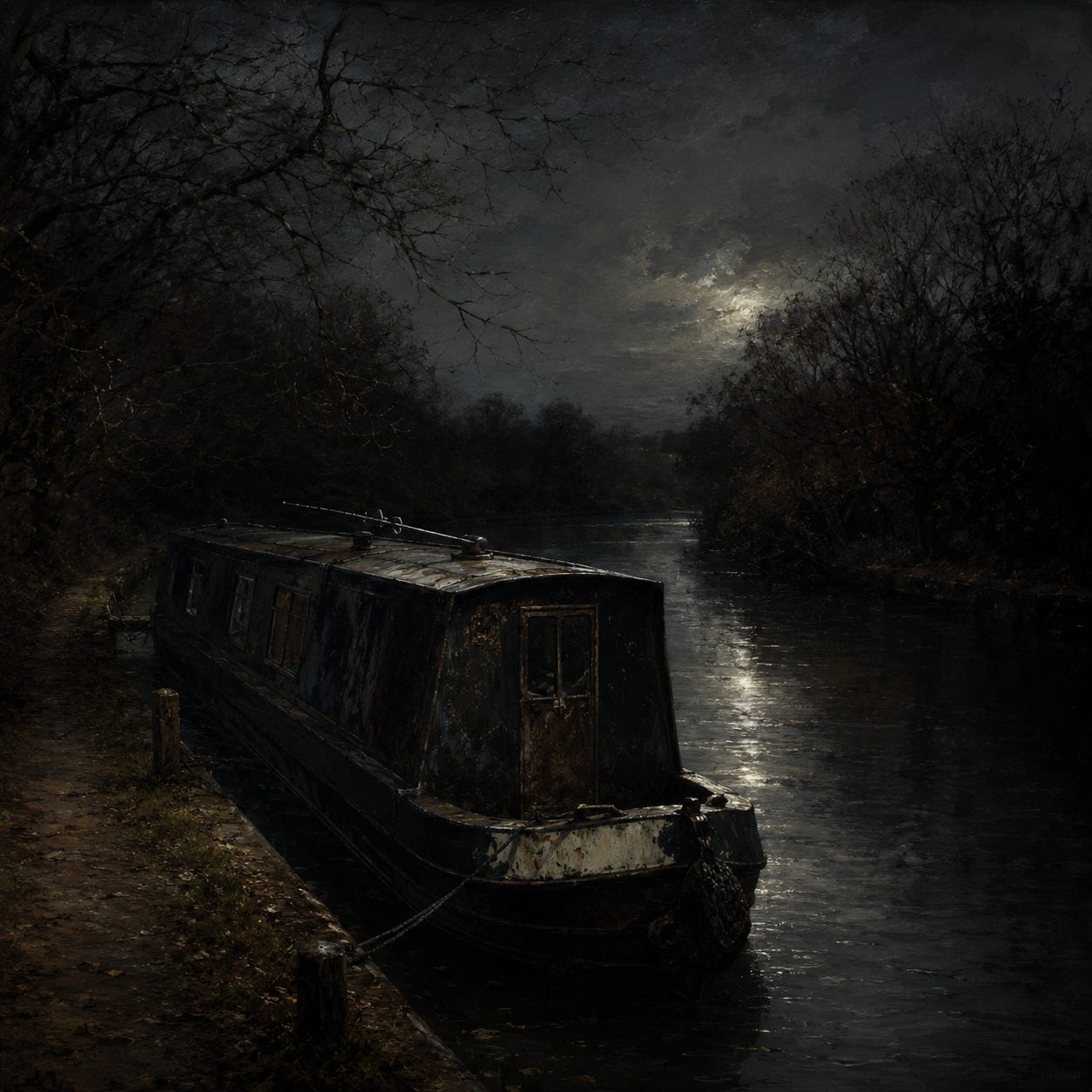
By half three the light had gone the colour of old bruise. It lay long and low over the Grand Union, caught in the beads of drizzle that never quite committed to rain, and turned the surface of the canal into something between slate and skin — something organic, almost breathing, as though the water were not water at all but the exposed underbelly of the year.
Nell Corrigan eased the hire-boat into tickover, hand light on the tiller. Her fingertips had gone numb inside her gloves; the November air came raw along the cut, funnelling between the hawthorned banks with the patient persistence of something that had been doing this since long before she arrived and would be doing it long after she’d gone. Ahead, the world narrowed to a strip of water and a ragged oval of sky — the world reduced to its essentials, she thought, like a sentence stripped of all its qualifying clauses.
“Four o’clock dark,” her mother would have said. “That’s when your sins come home.”
Nell had never discovered anything as dramatic as sins inside herself. But in the last year she had grown quietly acquainted with their minor cousins: thoughts you weren’t proud of, memories that had furred over like the bottom of an old mug — the residue of things you’d drunk and not quite finished.
Behind her, the engine muttered and shook in its small mechanical dream. From the cabin, Radio 4 leaked a documentary about the history of dial-up internet, the possessive croon of an older man talking about modems and handshakes and the particular tenderness of noise. She let it wash over her — that hiss and whistle of someone else’s nostalgia — and steered to the middle.
The cut here, between Leamington Spa and Braunston, was deep enough that she could imagine the land parting ahead of her like a slowly opening book. Bare branches leaned over from both banks. Every so often a bird spooked out of the scrub, a haphazard flurry of wings and complaint, and zipped low across the water to vanish in the opposite hedge — gone so completely it might never have been there at all.
“Another mile,” she said aloud, the way you did when you’d been alone all day and needed to confirm that your voice still worked, that you had not simply dissolved into the grey afternoon. “Then find a mooring. Tea. Heating. Slippers. You domestic goddess, you.”
The word goddess came out wrong — squashed and faint, the air pressing it flat. She tried again, on a breath that clouded in front of her like a small, brief ghost.
“Goddess.”
It had been three months since Dan had left. They had packed the last of his things into the boot of his car with a mutual care that made her want to bite something — not him, not herself, just something, just to feel the shape of her own teeth. Twelve years, undone quietly over four weeks, the split as administrative as cancelling a gym membership. No shouting, no objects broken, no wild confession about a second phone or a secret child. Nothing to put your back into. Just: this isn’t right anymore, is it? We’ve had a good run, haven’t we? I don’t want to hurt you. I’m sorry. Are you all right?
She had nodded. Said the reasonable things. Yes, you’re right. Yes, we’ve tried. Yes, I’ll be fine.
She had waited for the aftershock that never came.
Instead she found herself drifting in the oddest emotional frequency. Not grief, not anger. Something more like the space between radio stations when you turned the dial by hand — that soft, persistent hiss full of half-caught syllables and phantom songs, the feeling that if you held your breath and listened hard enough you’d hear what you’d missed. The feeling that the signal was there; that the fault was simply in your receiver.
The boat nosed under a hawthorn colonised by carrier bags and tatty police tape, then out again into open cut. She could see, up ahead, the faint geometry of a bridge.
Above the engine, the radio crackled. A presenter laughed at something a caller had said and repeated it. Nell didn’t catch the joke. She dipped the throttle, then brought it back, playing with the sound of the engine the way she might worry a loose tooth — not because it needed attention, but because the sensation was her own. This was only her second day; she was still enjoying the illusion of command.
A mile, she had promised herself. The light had other ideas. By the time she slid under the bridge arch, dusk had already puddled into the corners, pooling in the joints of the stonework like something spilled and not wiped up. The damp stone overhead sweated onto her face. On the far side, the cut opened into a widening — a slice of straight canal with room for several boats on each bank.
Three were already moored on the offside: one painted a tired dark green, the colour of a garden gone to seed; one matte black with no name, like a word deliberately omitted from a sentence; one blue with a mural of badly rendered swans. On the towpath side, opposite, stood a line of skeletal ash trees, their branches dark filigree against the fading sky.
The black boat had no signs of life. No chimney smoke, no glow from the portholes. On the cabin roof, a folded bike rusted gently beside a crate of sodden logs. It had the quality of a place that had been closed up carefully — not abandoned, but set aside, the way you set aside a book you intend to return to.
“That’ll do,” Nell murmured.
She slowed to reverse, nudged the stern in, hopped off with more confidence than grace, and got the mooring lines around the rings. Her breath came white and ragged as she hauled; the rope burned a little through her gloves, a small, clean pain. When she had the boat snugged in behind the black one — her hire-boat bumping it companionably, as though they had known each other a long time — she tied off and stood for a moment on the towpath.
Silence collected in the cut, stratified like mist. Somewhere far off, a dog barked, then thought better of it. A car passed over the bridge she’d just come under, a private swoosh of rushing — someone going somewhere, certain of their direction.
The three boats hunched in a row, windows dark, their roofs shiny with damp. She glanced at the black one. No curtains twitched. No duck feeder, no rotting barbecue. An empty feel to it, as though it had been closed up for winter and left to dream of April — to dream, perhaps, of a specific April, one it had been promised and was patiently awaiting.
“Evening,” she said to it, because she couldn’t quite bring herself not to.
The boat said nothing. That seemed fair.
Inside her own cabin, it was instantly warmer, despite the chill creeping off the steel. She started the stove — one of those small, glass-doored affairs that gave off much more charm than heat — and fumbled for the radio, switching it from mains to battery so she could have it on while she cooked.
Not that there was much cooking. She heated a pan of supermarket soup, hacked at a baguette with a too-small knife, and managed to butter a third of it without tearing it into shrapnel. On the radio, the six o’clock news performed its liturgy of catastrophe: currency fluctuations, a leadership challenge, flooding somewhere she had never been.
After, she washed up to the comforting clink and slosh of crockery in a tiny sink, then sat at the table with a book open and unexamined. The cabin smelled of woodsmoke and onions and damp wool — the smell of being alive and slightly underprepared. When she breathed in, her chest made a faint wheeze, a sound like tuning past something you once knew the frequency of and failing, this time, to catch it.
She realised, with an almost academic interest, that she was tired all the way through. Not the simple, finished-a-long-walk tired, but a complicated, bone-deep fatigue — as if every part of her had been holding a note too long and now didn’t know how to let it go. The note had no name. It had simply been there so long it had begun to feel like silence.
At eight-thirty she gave up pretending to read, went outside to check her ropes, and looked up at the bank.
The towpath was a cool grey strip in the dark. Above it, the trees were only suggestion — the idea of trees, the memory of them. There were no other people, no dog-walkers with apologetic torches. On the offside, the black boat lurked, its metal skin beaded with moisture, patient as a held breath.
And from inside it, faint at first and then distinct, came the sound of a radio.
Nell went still.
It was the unmistakable susurrus of tuned-in somewhere-else: that faint carrier tone, that low-level hiss beneath human voices, like the sound of the world thinking before it speaks. Not music. Talk.
She found herself turning her head like a dog, trying to get a better aerial. The sound drifted across the short gap of water, thinned by it. The words were almost clear, then not — like a face glimpsed in a crowd that might be someone you know.
“Hello?” she called, because of course someone would have turned up when she was cooking, gone off to the pub over the bridge for a pint, come back while she was reading. Of course the boat wasn’t empty.
The voices did not pause. They went on, intimate and measured, indifferent to her.
She stepped onto her bow, then onto the gunnel, then to the short stretch of bank between the boats. The towpath was a foot higher here; she clambered up, grasping at a branch. The damp bark came away under her hands in soft, wet strips.
Closer, the sound clarified.
“...no, I know,” a woman was saying. “I’m not — I’m not asking you to be reckless. I just — we’re not children, are we? We don’t get infinite shots at this.”
The man’s reply was lower, sunk into the noise. His vowels had a Midlands flattening she half-recognised — not from a face, not yet, but from somewhere in the body’s older archive, the place that catalogued voices before the mind had thought to name them.
Nell walked slowly along the line of the two boats until she was opposite the bow of the black one. No light showed at the portholes. No slip of curtains, no tell-tale reflection of a phone screen. Just that voice: careful, slightly breathless, talking to someone she already trusted enough to argue gently with.
Nell cleared her throat.
“Excuse me?”
The woman’s voice carried on.
“If we did this — and I’m not saying we should, I’m not, I’m just — if we did, then what? I’m in Brighton. You’ve got your son, and your job, and your whole life that’s — it’s not me-shaped. I’m not asking you to mould it round me, but I’m also — I can’t do a fantasy, Liam. I can’t be a holiday.”
Nell blinked.
The man — Liam — laughed, a brief, embarrassed puff. “You make it sound like you’re some package deal. Two weeks in the sun, all inclusive.”
“I sort of am,” the woman said. “Bit pale for it, mind.”
The small joke loosened the tension in his voice. “You’re not a holiday.”
“Then what am I?”
Static swelled in the gap that followed, as though the radio were thinking — genuinely deliberating, as if it, too, had a stake in the answer.
Nell stepped closer still, until she could lay her palm flat against the steel of the black boat. It was slick-cold and unyielding. All her senses, which had been dulled by soup and fatigue, felt suddenly honed to a single, fine point. Her stomach had gone fizzy, the way it did before news you couldn’t predict.
On the top of the cabin, a squat car-radio aerial lay along the roof like a discarded whip. No glow seeped from beneath the hatch. No sound of movement, no clink of mug or creak of floor.
Inside, Liam said slowly, “You’re — someone I wasn’t expecting to want.”
“That’s hardly reassuring.”
“No, I mean — Hang on, start that again.” He huffed, exasperated at himself — and there it was: that particular exasperation, the kind directed inward, at one’s own failure to find the right words for an important thing. “I thought I’d had — you know. My go. With this stuff. With feeling like this. And then you — turn up, being all — you.”
“That’s specific,” she murmured.
“You know what I mean. You make me feel like — Christ, I’m not twenty-two, I shouldn’t be saying this.” A pause, and in it something decided. “You make me feel like it might be worth the mess.”
Nell knew, with a clarity that felt like warning, that what she was overhearing was not the blur of some late-night phone-in. It wasn’t an audio drama. These weren’t actors on a script. The pauses were too untidy; the sentences did not arc to convenient conclusions. The woman’s breath hitched now and then on nothing — on the small, involuntary catches of a person trying to hold themselves together while saying something true.
She had never heard this programme before. She had been idly tuned to Radio 4 all day; there had been trailers for the evening’s content. This was none of them.
“I’m not sure my son would agree,” Liam added. “He’s only eight. He likes things — simple.”
“We don’t have to be complicated,” the woman said. “We just have to be — I don’t know. Honest? Not in a disclosure-form way. Just — not lying about what this is.”
“What is this?”
“Well. That’s the question, isn’t it.”
Nell waited for the reassuring in/out of movement, some silhouette at a window. Nothing. Her own breath sounded too loud in her ears, muffled by the wool of her hat.
She walked the length of the black boat again, checking every gap between curtain and frame. The seams were tight. A thin mossy line ran along the waterline, proof that it hadn’t moved for some time — perhaps all season. Whatever was happening inside was not happening in the usual way of things.
The tail of the conversation floated out behind her as she went, like a story unfurling down a page she hadn’t meant to read.
“...wouldn’t ask you to choose.”
“You would,” Liam said, without heat. “Not on purpose. Just by existing in my life.”
“I exist without your permission, you know.”
“I’m painfully aware.”
“Well. That’s your problem.”
He laughed — helpless, caught — and Nell felt her throat contract on some old reflex. She knew that laugh. Not that actual sound, but the shape of it. The cautious delight of a man who had not expected to fall into this conversation, who was both pleased and appalled to find himself here, in this new country, without a map.
She stayed until her fingers hurt with cold, until it occurred to her that she might as well be standing outside a stranger’s window with a glass to the pane. Then she went back along the bank to her own boat, the voices trailing after her like tin cans on a string — cheerful and slightly absurd and impossible to ignore.
Inside, her radio had gone to that soft mid-band fuzz, the nothing-everything of between stations. She checked the dial: FM. Still tuned where she’d left it. She touched the volume knob. The static got louder, as if offended by the enquiry.
She switched it off. For a moment the cabin was entirely soundless, save for the tick of the stove — a sound like a small, steady clock measuring out some other kind of time. Then, so quietly she almost thought she’d imagined it, the woman’s voice slipped in again from outside.
“...I just don’t want to be the mistake you wish you hadn’t made,” she said. “Or the regret you’re glad you had. I don’t want to be — a story you tell.”
“Too late,” Liam said. “You’re already a story.”
Nell lay in her bunk that night listening until the shapes of the words blurred into sleep. Around ten, their voices softened. Around eleven, they were still circling — more tired now, worn smooth at the edges — as if they had looped a dozen times and still hadn’t found their way out, and were beginning, perhaps, to suspect that the way out was not the point.
When she woke at three-thirty from a strange, fragmented dream in which she was trying to retune all the radios at once in her old student house — twelve of them, each on a different shelf, each pulling toward a different frequency — the night had gone thick. The stove had dulled to red crumbs. The black boat was a silent wedge in the darkness, its presence felt more than seen, the way you felt a person standing just behind you before you turned to look.
The next morning she told herself she had imagined it.
That this was what came of floating alone down a grey canal after the end of something almost but not quite like a marriage. That she had dozed in front of an absurdly written drama and transposed it onto the geography of her loneliness.
She untied with stiff fingers, pushed off from the bank, and let the boat slip forward into the dim day.
By lunchtime she had convinced herself. By three, approaching Braunston Tunnel in a short-lived flare of weak sunshine, she no longer believed in voices that came from nowhere. She believed in damp, in the aching between her shoulder blades, in the mild terror of steering through a mile of dripping brick with someone’s impatient cruiser thrusting at her stern.
She came out of the far portal in a splatter of light, blinked, laughed, and — entirely by accident — put on the wipers.
The tunnel water ran down the glass in long, slow streaks, like the aftermath of something. Up ahead, the canal bent away, skirting the hill. Pastoral complacency: fields, a hedgerow, the gentle rise of a towpath. A dog lolloped along it, attached loosely to a woman in a bobble hat. The woman raised a hand in the ceremony of canal etiquette. Nell raised hers.
She had planned to moor that night near the village, to treat herself to a pub meal she could neither afford nor justify. She even saw the place from the water: hanging baskets dead but hopeful, the red glass of an empty fire extinguisher visible through the window, like a small stopped heart.
She did not stop.
Instead, to her own faint bewilderment, she chugged on past the mooring rings and the collection of boats that orbited the services. On under one bridge, then the next. Until the hedges grew taller, the trees leaned in, and she recognised — with the odd sensation of having arrived inside yesterday’s dream — the same deep cut. The same skein of hawthorn bags. The same offside rings.
The same black boat, still hunched in its place, its paint swallowing what little light was left.
“Ridiculous,” she told the cabin as she moved to the bow. “Absolutely ridiculous.”
Nonetheless, she tied up exactly where she had tied up the night before, close enough that she could have leaned across and touched the other boat with a broom handle.
By the time she had the lines secure, darkness had dropped — abrupt as the click of a hall light. A wind she hadn’t felt out in the open rose in the cut and moved the trees very slightly. The sound was soft, like distant applause from an audience that had been waiting a long time.
She didn’t even turn her own radio on that evening. She heated a tin of beans on the hob, ate them with toast speckled in burnt patches, and sat at the small table, pen hovering over a postcard she’d bought in Warwick — a castle in theatrical sunlight, the kind of light that only existed in photographs and memory.
Dear Mum, she wrote, and stopped.
What was she supposed to say? Boat nice, weather shite, voices on abandoned vessel broadcasting lovers’ quarrels from somewhere outside of time? Wish you were here?
She dropped the pen and pressed her knuckles against her eyes until coloured flecks swam behind them.
Her body wanted to cry. Her chest had that hot, trapped feel. But there was nothing there — no big shape of sadness to push out. Just the hiss-flutter of unnamed frequencies, the sense of a signal she couldn’t quite resolve.
At half nine, it began again.
She felt it first as a pressure change — a faint hollowing in the air of the cabin, as though something outside had drawn a breath. Then, threading under the hum of the fridge and the burn of the stove, came the distinct rise of a voice.
“...no. No, you’re right.”
The woman. Same timbre, same unvarnished clarity. As if she had never stopped speaking and Nell had only just come back into range.
Nell stood. The postcard slipped from her lap and skated to the floor.
She opened the cabin door and stepped into the chill.
From the black boat, the radio played. This time the words were sharp from the first — no distance to cross, no thinning. As though the boat had moved closer while she wasn’t watching.
“I can’t do it,” the man said. Not Liam, not quite; he sounded as if he were hugging himself against a cold that had nothing to do with November. “I’ve been thinking about it all week, and I just — I can’t. It’s not — it wouldn’t be fair.”
“I know.”
“And that’s not — I’m not saying you’re asking for something unfair. You’re not. You’re being the — the grown-up, actually. I’m the one who’s — My son, he’s — he’s only eight. He still comes into my bed when there’s a storm. He still cries if I’m late at pick-up. I can’t introduce you and then — what if it goes wrong? It probably would go wrong. That’s how this stuff works, isn’t it? It’s brilliant and then — then it’s — not.”
“I know.”
“I’m not saying you’re not worth the risk. God. You’re — you’re absolutely —” He stopped, started again. “But his mum would — It’d be a war. And you’d be in the middle. Or not even in the middle. On the edge somewhere, getting shrapnel. I can’t do that to you. Or him. Or me.”
“It’s all right.”
“It isn’t.”
“It is.”
“It isn’t. Don’t be — Don’t do that thing.”
“What thing?”
“Where you make it easier for me to — to be a coward.”
Nell found her way along the short path to the towpath by feel more than sight. The grass crackled under her boots; the dew was already frosting, the world hardening around its edges. Above the cut, a thin strip of stars had appeared, uncertain — as if they, too, were still deciding whether to commit.
She put her hand on the black steel again, like a believer touching a relic — something that might not be holy but had been touched by enough people hoping that it had become so.
From inside, static swarmed like a far-off sea. It ebbed and flowed around the words, lifting them and setting them down.
“You’re not a coward,” the woman said, with a steadiness that sounded earned rather than innate — the steadiness of someone who had practised being calm about things that hurt. “Or not more than anyone.”
“That’s damning with faint praise.”
“You’re being a dad. That’s allowed to come first.”
“Doesn’t stop me feeling like an arse.”
“Well. You can feel whatever you like. That’s your bit.” A tiny breath of laughter, derailed. “Mine is — I had a choice, too. I knew what this was when I — when we — when I stayed on the phone after that first coffee instead of saying, ‘Well, that was nice, goodbye.’ I knew what it was when I got on the train. I knew what it was when I got off.”
“You didn’t know it was this.”
“Some version of this,” she said. “This is how it goes, at our age. There’s always someone else’s map drawn over yours. Kids. Exes. Exes’ kids. Parents you can’t leave. Jobs you can’t move. You can’t ask someone to take all their lines away just because you fancy drawing new ones.”
“I wanted to.”
“I know.”
“I wanted to say sod it, let’s — just do it, let’s not think. God, I wanted to. You’re —” He stopped. “You’re the first person in years who’s made me want to be bloody stupid.”
“That’s a compliment, I suppose.”
“It is. It really is.”
The woman took a breath that slipped once, almost caught. “And I meant it, you know. I wasn’t — I wasn’t hedging. When I said I could — move. If you wanted that. Eventually. If that’s what — if we were —” She stopped. “It doesn’t matter now. I meant it.”
“I know you did. And that’s — that’s the bit that — I can’t forget that you offered that. I can’t be the man who took it.”
“So you’ll be the man who doesn’t.”
“Yes.”
Silence, thick as wet wool.
“Okay,” she said at last.
He made a low, involuntary sound. “You’re taking this too well. I’d — shout at me, at least. Throw something.”
“You’re on the other end of the phone.”
“I’ll wait.”
“Don’t be an idiot.”
“Too late.”
She laughed then — properly, if briefly. The sound was the saddest thing Nell had heard in months: a laugh that knew exactly what it was doing and did it anyway.
They did not shout. They did not blame. They did the ordinary, intolerable work of unpicking something that had barely been woven: the logistics of returning each other’s books, of dealing with already-booked train tickets and a gig in December they’d planned to go to “if we’re still not sick of each other by then.”
“Keep the ticket,” he said. “Take someone else.”
“It was your band,” she said. “I’ll just think of you singing along and looking smug because you guessed the encore.”
“Still smug even now.”
“Always.”
The static built around their goodbyes like fog, swallowing the outlines, softening the edges of things until there were no edges left.
“I’m —” he began.
“Don’t,” she said.
“But I am. I am sorry.”
“I know. So am I. That’s the boring part. We’ll both be very, very sorry and very, very fine and we’ll tell people, I had this thing, actually, and I’m still — I’m all right, really.”
“You will be.”
“You will be.”
“I don’t want to get off the phone.”
“I know. Me neither. But we’ve done the hard bit. We just have to — do the stupid bit.”
“What’s the stupid bit?”
“Actually — getting off the phone.”
He gave a breath that was not quite a laugh, not quite a sob — a sound that existed in the narrow space between those two things. “Okay. You hang up.”
“No, you.”
“God, we’re pathetic.”
“We are,” she said softly. “Goodbye, Liam.”
“Goodbye, Ruth.”
The hiss surged. For a moment the whole universe seemed made of noise — every frequency opened at once, a vast and indiscriminate tenderness.
Then, as before, it ebbed. The cut was just a cut again. The black boat sat with blank-faced composure, no wiser for what it had contained.
Nell realised she was crying.
Not weeping — not the elegant slide of tears down the cheeks that films offered, that graceful, photogenic grief. Old-fashioned crying, the sort that made your nose run and your throat go raw, the sort that had no dignity and didn’t ask for any. The sort that felt bigger than you and, at the same time, stupidly small — as though you were a child again, crying about something you couldn’t name, in a room where no one was coming.
It surprised her, this. That it wasn’t her own ex she was seeing, not her own conversations being unpicked for a different outcome. It was two strangers, with their half-built thing — their unshared mornings in kitchens they hadn’t moved into yet, their imaginary toothbrushes in each other’s glasses.
She sat down on the low bank between the boats and let herself have it — the whole messy broadcast of it: the regret, the relief. Because there was relief, curling quiet under the sharpness. Relief that they had not, in the end, decided that love was worth smashing into the people around them. Relief that they had also, once, felt it might be. That they had stood at the edge of that recklessness and looked down and understood its dimensions.
When the last ragged sobs had faded into shallow hiccups, she wiped her nose on her sleeve and laughed at herself — shaky, a little embarrassed, obscurely grateful.
“Sorry,” she told the black boat. “Didn’t mean to get personal.”
It said nothing, in a studied way.
That night, she dreamed of them.
She was in a room of doors — more doors than the room could reasonably contain, stacked and layered like the pages of a book. Behind each one, Ruth and Liam sat at different tables. At one, Ruth sat alone with a cat on her lap; at another, Liam had a different child — a daughter who drew endless horses and handed them up to him to admire, and he took each one seriously, the way you did when someone showed you something they had made.
The doors had no labels. When she opened one, the others shifted very slightly, as if trying not to be seen. As if aware of the danger of being looked at directly.
She woke with the image of them still in her mind: not as they were, but as they might be, multiplied — a whole spectrum of them, each version as real as the last.
On the third night, she did not pretend she was going anywhere else.
She spent the day in a slow loop between her boat and Braunston village, walking the towpath instead of cruising, letting her legs remember something other than forward/neutral/reverse. The weather had settled into a kind of clear cold that made her teeth ache and her thoughts sharp and simple. Frost clung all day to the shadowed banks, refusing to yield even when the weak sun found it.
On the way back, as the light thinned once more into the narrow hour between grey and black, she found herself talking out loud, rehearsing for a conversation she would never have with anyone.
“You should do it,” she said to the hedge. “You should absolutely do it. Life’s too short. You’ll regret it if you don’t.”
Then, a hundred yards later: “Don’t. You’re right not to. It’s not just about you. Don’t let someone move their whole life and then resent you for every missed parents’ evening.”
The hedge, like the boat, had no view.
The sky had turned the deep indigo that only came in late November — that brief, particular hour before the dark completed itself. The first star pulsed above the ash trees, tentative. Her breath came in soft white shapes, each one different, each one gone before she could name it.
She made tea, burnt a crumpet, scraped the black bits off with a thumbnail and ate it standing at the hob. At eight-thirty, she put on her coat and went out to wait.
She sat cross-legged on the sodden bank opposite the black boat, gloved hands jammed between her knees. The steel rose beside her like the flank of some sleeping animal — something enormous and patient, indifferent to cold. Somewhere overhead, invisible in the dark, a crow bid the day a bad-tempered farewell.
For a time there was nothing. Only the drip of condensation from branches, the distant thrum of the occasional car over the bridge, the gentle ticking of cooling metal as the boats along the line gave up their heat one degree at a time.
Then, as if someone had slid a fader up in some unseen mixing desk, the radio came in.
“...if we’re going to be ridiculous,” Ruth was saying, “we might as well be properly ridiculous.”
Liam’s laugh was open, unguarded — the laugh of a man who had stopped bracing himself. “Define properly.”
“Oh, you know. Keys. Toothbrush. One of those hideous mugs your son made you at school cluttering up my cupboard. Buying a joint sofa and worrying if we’ve picked the wrong grey. Arguing about the bins. Being — ordinary.”
“Nice sort of ridiculous,” he said. “I was thinking more — weekend in Paris. Hotel room. No one knowing where we are.”
“That too,” she said. “But the other thing as well. I’ve done the secret thing. The affair thing, if we’re being honest. I’ve done the thing where you’re always waiting for the other shoe to drop. I want the thing where we’re arguing about whose turn it is to unload the dishwasher and we know we’ll still be there tomorrow to keep arguing.”
“We don’t have a dishwasher,” he pointed out.
“Future dishwasher, then. Imaginary. A dream of a dishwasher.” She paused. “Unless you’re a hand-washing purist, in which case this might not work.”
“I’m a single dad,” he said. “Without a dishwasher I’d be dead.”
“Oh, thank God. See, compatibility.”
She laughed and he laughed with her, and their mirroring felt so solid, so lived-in already, that Nell’s chest tightened with something that was not quite envy and not quite joy but contained elements of both.
“How’s he going to take it, d’you think?” Ruth asked, after a small pocket of static.
“Who, the dishwasher?”
“Very droll. Your son.”
“Hmm.” He made a mulling noise — the sound of genuine consideration, the sound of a man taking a question seriously. “He’ll be suspicious. He’s a suspicious kid. But he’ll also — he wants me to be happy. He doesn’t have the language for that, but he does. He tells my mum off if she moans at me. ‘Grandma, don’t make Daddy sad.’ That sort of thing.”
“Oh,” Ruth said, softly. Just that.
“And he’s asked about — you know. Why I don’t have a girlfriend. ‘How come you don’t kiss anyone, Daddy?’”
“Very nosy.”
“Tell me about it. You should’ve seen his face when I said, ‘Well, I just haven’t met the right person yet.’ Proper eight-year-old scepticism. Like, sure, mate. Pull the other one.”
“And now you have,” she said.
“And now I have,” he echoed.
Silence. But not the painful sort. The breathing-in sort — the silence of two people who have said the important thing and are letting it settle, the way you let a chord ring out after you’ve struck it.
Nell found herself smiling along with them. It was absurd. She was sitting on a damp notch of earth between two narrowboats, her backside freezing, grinning like an idiot at a love story that did not know it was being overheard.
Time behaved oddly in the cut. The voices seemed to stretch and compress it, the way music did — the way certain songs could make twenty years collapse into three minutes, or make a single evening feel inexhaustible. At some points she could have sworn she’d only been listening a few minutes; at others, whole hours unspooled in the space of a breath.
What unnerved her most was the way snippets began to overlap in her memory, splintering into different directions. She remembered Ruth saying “I can’t do it” and “I really, really don’t” with equal emphasis, as though both statements were true simultaneously, as though the same voice could hold two opposite certainties without contradiction. She remembered Liam laughing and Liam not-quite-crying, both on the same syllable.
It was like holding a prism up to a narrow beam of light and discovering that, inside, there were whole spectrums waiting — colours that had been there all along, simply uncollapsed, waiting for the right angle.
Somewhere between “our kitchen” and an absurd three-minute debate about whose toast crumbs would inevitably end up in whose butter, Nell understood.
This was not a series of nights.
It was not even a sequence.
The black boat was not giving her a chronological account she could map if only she listened hard enough. It was broadcasting all of it — all their possible routes, threaded together, flickering between them faster than she could parse: the version in which they never got past the “I can’t do it” night; the one in which Ruth moved and found she hated the Midlands; the one in which they lasted three years and then separated with crushing politeness, swapping a sofa and a record collection and a cat who sulked for months. The version in which they made it — thirty years, sunburnt holidays, his son grown and strange and dear. The version in which they never tried at all but carried each other like a coin in a pocket, worn smooth on the bad days.
The broadcast did not differentiate. It offered each like a track on an album played in shuffle mode, the edges blurring, the transitions seamless. Love in all its uncollapsed forms, simultaneous, patient, waiting to be observed.
Nell sat very still, suddenly afraid to move in case she jostled something essential, in case her presence in the listening was already doing what presence always did.
“Careful,” she whispered to herself — half-amused at the madness of it, half-deadly serious. “Careful what you — do.”
She began, shortly after that, to talk back.
Not much. She was not under the illusion that she could tune them. But there were moments when she could not help it.
“No,” she said, when Liam minimised his own capacity for joy, twisting it into a joke before it could be taken seriously. “Don’t do that. Say what you mean.”
“Yes,” she said, when Ruth admitted, in a rustle of embarrassment, that she wanted to send a text just to say good morning and felt foolish — forty and foolish and hopeful. “Yes, do it. For God’s sake, yes.”
The canal took her words and made what it liked of them. Sometimes they seemed to hang in the air between the boats, threads that did not quite touch the other shore. Sometimes, in the pauses on the radio, she fancied she heard an echo — not of her voice, but of the impulse behind it.
“You’re talking to a boat,” she told herself. “You’ve reached that stage. Well done. Next stop, naming the spoon.”
But she stayed. She gave in and altered her plan for the rest of the holiday, padding her schedule with extra cruising hours so she could afford one more night in this notch of water. The hire company didn’t need the boat back till Saturday. It was only Wednesday.
She became protective of them, these two disembodied voices — fiercely, irrationally so. When a jogger came down the towpath with music leaking from their headphones, she bristled. When another boat, louder and brassier, came past in the night with revellers on the roof, she felt an absurd fury that their laughter might drown out a critical line of Ruth’s. She was not their guardian. She knew that. But she was their witness, and that, it turned out, was not nothing.
Mostly, though, it was just her, the dark, and the sound of possibility.
Sometimes, late, when the conversation on the radio stilled and the static thinned to a husk, she sat with the blackness pressing in and felt the old, particular ache of her almost-love.
The one from university. The man she had once nearly told everything to on a night not unlike this. The towpath then had been in Oxford, the river not a canal but a slow, steady Thames. She had been twenty-one and drunk on cheap cider and the fact of being young, and he had carried her shoes and said, lightly — so lightly, as if it didn’t matter, as if it were just a thing you said — “So, are we going to kiss now, or what?”
And she had laughed, and said something about ruining the friendship, and the moment had subsided like a wave running out of energy before it hit the shore.
Later, when she knew herself better — when she understood why that laugh had come so quick and bright, what it was she’d been defending against — she had replayed it like a faulty track. Sometimes, in the versions she carried, she told him. Not everything, but enough. Sometimes he did not run; he smiled, slow and wide, and said, “There you are.” Sometimes he kissed her, and it was nothing like she’d imagined and far better.
In reality, he’d moved away after graduation. She’d seen, through the loose network of social media, that he’d married someone kind-eyed. They had children now — small, fair-haired things who looked like him. She’d been glad. Genuinely. Even in the days when she and Dan had dug themselves into a trench of habit, that alternate path had glowed in the corner of her mind: not as a regret, but as a curiosity. A parallel channel. The station you might have found if you’d moved the dial a fraction to the left.
“Funny,” she said once, to the cold air and the black hull. “You get one almost and spend the next decade tuning every noise to its frequency.”
If the boat had an opinion, it kept it to itself.
On the Friday — the last full day of her holiday — the weather turned mean. Rain came in sideways bands that rattled on the cabin roof and smeared the windows into impressionism. The bank became a slip of mud. She stayed inside as much as she could, socks thick on her feet, jumper sleeves pulled down over her hands.
She did a jigsaw she found in one of the boat’s cupboards — a thousand-piece photograph of a harbour at sunset. At one point she realised she was muttering, “No, that doesn’t go there,” and had no idea if she meant the pieces or the people on the radio.
By dusk, the rain had drained away, leaving the world scrubbed and sharp, every edge re-committed. The sky cleared in strips. The air bit.
She knew she should be planning the route back. But there was no rush. An early start could make up ground. One more night here. Just one more.
At eight-fifteen, she put her coat on.
At eight-twenty, stepping outside, she saw them.
They were coming along the towpath from the direction of the bridge, towards the notch where the boats were moored. A man and a woman, walking quietly together in the cold, their breath making small clouds that dissolved before they could be called shapes. Their body language carried that particular charge: open, angled slightly towards each other, not yet colliding but leaning into the possibility of it — like two flames in a draught, each bending toward the other’s heat.
The man’s hat was pulled low, his scarf wound up. The woman’s hands were thrust into the pockets of a parka. Their steps matched without conscious effort. They were talking — too quietly for her to make out the words — but she could hear the cadence: the question-and-answer of people feeling for each other’s edges, testing the weight of things.
She knew the man’s gait before she knew his face.
It was in the way he shrugged one shoulder higher now and then, as though adjusting a rucksack he wasn’t wearing — a habit so specific it could only belong to one person, a piece of physical grammar as distinctive as a signature. The way he occasionally glanced sideways and down, as if at something shorter than him. An old habit of looking at her, in cheaper days, when she’d sat on the wall outside the college library, feet swinging, pretending to read.
Her heart did something unpleasant, like missing a stair.
When they came under the weak light that spilled from her cabin window, she saw him properly.
Liam. Older, of course — laugh-lines deepened, hair receding a fraction at the temples, the face of a man who had lived inside his years rather than beside them. Except that was not his name. That was the name he wore on the radio, the name the broadcast had given him. Here, in the solid air, in the actual dark of a November canal, he was the person she had known at twenty-one. Tom — with his mitochondrial lectures and the doodles of galaxies in the margins of his notes, Tom who had once said “Are we going to kiss now, or what?” and then, because she had laughed, never again.
He was ten feet away, in a dark cut near Braunston, walking with a woman whose voice she knew better than some of her own friends’. Ruth, in a parka, breath misting. Both of them exactly themselves, and also — she understood now — every version of themselves the radio had offered, all of them present in the single fact of their walking together in the cold.
Nell’s fingers tightened on the cabin frame.
The realisation came cold and clean, like water from a tap you’d forgotten was this cold.
The radio had not been broadcasting strangers. Or not only strangers. It had been broadcasting him — a version of him, spun forward along the line she had stepped off years ago, entangled with someone she had never met. The cut had been playing back a future that had always been running on a parallel track, close enough to receive if you were in the right place, in the right silence, with the right kind of emptiness inside you to act as an aerial.
She stood there, hand on the wood, and understood.
If she stepped out now, onto the towpath. If she said his name. If she let her voice go up at the end in that particular old affection — “Tom?” — she would collapse the wave. She would fix it. She would make one version real and, in doing so, make all the others impossible.
He would stop. He would turn. Recognition would flicker across his face, because of course it would; a decade and more of his life had not erased the girl who’d almost kissed him by the river. He’d laugh, delighted, and say, “Nell? What the — God. Look at you.”
Ruth would smile, politely uncertain, and he would introduce them, and the air between the three of them would crackle with coincidence. They would talk about how small the world was, what were the chances, you on a boat, us on a walk. Somewhere in his mind, the tracks would rearrange.
Maybe nothing would change. Maybe their walk would end the same way it was already ending, on one of the thousand frequencies, with a hand brushing a sleeve, a decision made at a gate, a kiss behind a hedge in the dark. Maybe her brief appearance would be a story they told later: “We ran into this woman I knew from uni, can you believe it? On the canal, of all places.”
Or maybe —
Maybe a word here, a glance there, the flick of an eyebrow, the offer of a drink on the boat to warm up, would tip it. Tom would find himself remembering not just her name but a whole other potential — the almost-life he’d once nearly had. He would look at Ruth and see, for a second, not just the woman beside him but the full weight of the life attached to him, and he would falter.
Or the opposite. Perhaps Ruth, meeting this odd woman from his past, would see the way his eyes softened, and something protective in her would flare — a small, necessary adjustment. A percentage point shaved off the probability of one outcome and added to another.
She had listened, for three nights, to the fragile, ferocious business of their becoming — to all the ways they might bruise and heal and remake themselves around each other, to all the versions in which they never quite happened but left smudges on each other’s lives, the kind that don’t wash out. She had been, without meaning to be, the keeper of their uncollapsed futures.
She found, now, that she could not bear to be the one who shut any of that down.
To tip the balance for them would be to choose — arrogantly, blindly — on their behalf. To say: this is better. This is the route you should have.
She thought of her younger self on the towpath in Oxford, laughter too bright, too quick, a sound deployed like a shield. How often she had, in low hours, imagined someone wiser stepping in — some future version of herself appearing at the edge of the scene to say, “Tell him. Use the words. You don’t have to make a joke out of it.”
Would she have listened? Maybe. Maybe not.
Would it have made what came after better?
Who knew.
There was a courage, she realised with a small, cold shock, in not intervening. In letting people walk their own edges without grabbing at their sleeves. In trusting that the life they were living was, in some essential way, theirs to live — with all its wrong turns and its near-misses and its particular, irreplaceable griefs.
To witness was already to change. To name was to fix. To stay silent was to give the universe a little more room.
She stepped back, very gently, into the shadow of her cabin door.
They drew level.
Tom said something. Ruth laughed, tipping her head back — and in silhouette she was only outline: nose, fringe, the curve of a cheek that Nell had heard for three nights and was only now seeing. Their breaths made small ghosts in front of them, rising and dispersing.
They passed her boat.
For a wild heartbeat she nearly called out anyway, because human instinct was strong, and part of her ached to stand in front of him — to see how his eyes crinkled now when he smiled, whether he still spoke with his hands, whether time had been kind or merely honest.
She did not.
She stayed in the alcove of shadow, ten feet away and invisible. She watched him slow, almost imperceptibly, as they came level with the black boat — as if sensitive, somehow, to the static in the air, to the accumulated weight of all those broadcast futures pressing against the steel. As if some part of him felt it without knowing what it was.
Then they went on, their footsteps soft on the damp towpath, heading towards the bridge, towards however many futures lay folded like paper cranes inside the next few hours — each one waiting to be unfolded, each one containing a different kind of flight.
Nell closed her eyes until they had gone.
She waited a full minute, listening to the receding murmur of their voices, the slight clatter as they negotiated the stone steps to the road. Only when she could no longer hear them at all — not even the suggestion of them, not even the shape of their absence — did she go back inside.
The cabin felt smaller and larger at once — the familiar paradox of a room you’ve returned to changed. She put the kettle on reflexively, the domestic ritual a way of anchoring herself in one particular now, of insisting on the present tense.
The blue gas flame roared. The kettle began its slow, sensible boil.
From outside, nothing came.
No hiss. No distant chuckle. No careful, circling conversation threading through the dark.
The radio on the black boat was silent.
She waited for it to start up again — to offer one more variation, one more angle, one more version of the life she’d been given to hold. It did not. The only sound was her own kettle, beginning to mutter. The stove creaked as the wood inside shifted. Somewhere under the hull, something small bumped against the steel — a leaf, a twig, something the canal had been carrying and had now set down.
When the kettle clicked off, she made her tea and stood by the porthole, looking out at the dark.
The cut was a simple piece of geography again — water between banks, banks beneath trees, trees beneath sky. The black boat was just metal and paint, weathered and patient, keeping nothing now but its own silence. Somewhere above, hidden by the banks, cars crossed the bridge in small bursts of light, each one going somewhere, each one unaware of the particular significance of this particular stretch of water on this particular night.
She held her mug in both hands and felt the heat seep into her fingers.
Around her, the cabin smelled of the day’s burnt crumpet, still faintly acrid, and the particular damp-wool smell of her own coat hung by the door — the smell of herself, returned to herself. She glanced at her phone on the table, its screen bright and flat and absolute, showing her the time in a font with no ambiguity, no static, no possibility of misreading. 21:47. A Tuesday in November. Here.
The space in her chest felt changed — not filled (nothing so tidy as that), but tuned. Calibrated. The hiss between stations was still there, but threaded now with something else: the faint impression of chords, of songs she might find if she moved the dial a millimetre this way or that. Not the songs themselves. The knowledge that they were there.
She thought of Tom and Ruth walking on the dark towpath, their breath ghosting, their futures uncollapsed — all of them, simultaneously, beautifully possible.
She thought of Dan, in whatever flat he lived in now, perhaps standing at a window, perhaps brushing his teeth, living out his own particular frequency.
She thought of herself, here — on a boat in a November cut, alone in the way that was not the same as lonely, empty in the way that was not the same as hollow.
“Let it be what it is,” she said into the quiet. “All of it. Let it be.”
The canal, indifferent and patient, slid on through the dark.