

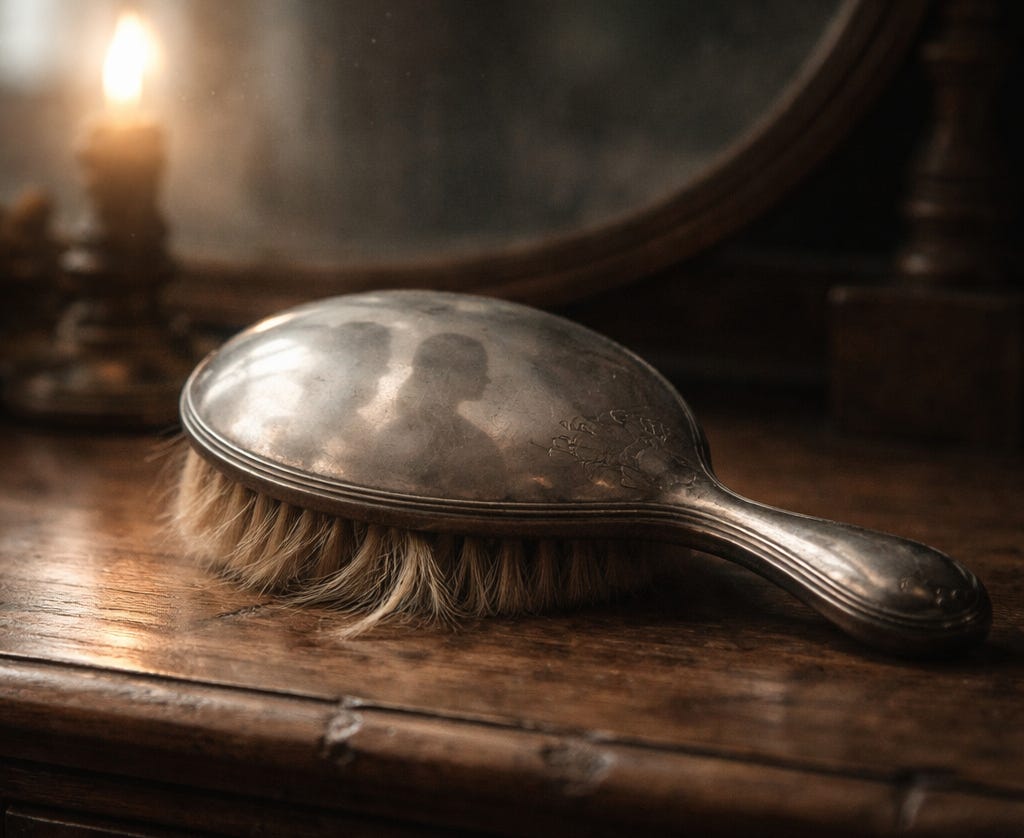
Hello, Across the Silver Line is a novella about two women — one in 1919, one in the present — who find each other through an ordinary object in a Bath flat that was once theirs both. It’s a quiet love story about loneliness, kindness, and the small gestures that constitute devotion when grand ones are impossible.
The opening is below. The full novella is available as the first of 3 stories in my ebook, Intervals. Beneath the excerpt, you’ll find both song settings of its companion lyric.
From the opening of Hello, Across the Silver Line
Claire
The hairbrush turned up in the back of the dresser drawer, smelling faintly of lavender and coal dust. It had a silvered back engraved with initials that might once have been crisp but had softened over years of handling—L. A. or perhaps E. L., depending on how the light fell. The bristles were boar hair, stiff and stained at the tips with an amber patina. When I held it, my fingers fit the curve as if I had been meant to. It was the sort of object estate agents call a period feature, though no one had mentioned it when I signed for the flat on the first floor of the Georgian terrace, the sash windows rattling like loose teeth, the chimneys fretted with jackdaws.
I moved to Bath because the days in London had begun to spool without punctuation, because my mother could no longer remember my name reliably and the care home near Larkhall had a room that looked out onto a magnolia tree. I told myself the move was practical. I told David that it had nothing to do with us, though we both knew I was running towards a place with bones older than my grief. Three years together, and in the end, we’d talked to each other through solicitors’ letters, dividing books and kitchen things like splitting atoms. The flat was a narrow set of rooms with an undulating floor, a fireplace bricked over, a cast-iron range that no longer aired bread but still exhaled a cold smell on damp nights. The dresser in the bedroom had a three-part mirror; somewhere in the centre wreath of the silvered brush, if I turned it this way and that, I could catch the dulled gleam of my own face and the shadow of the window behind me.
The first time I used the brush I did not expect any more than static. My hair is the sort that goes ragged in humidity and sullen in drought; it liked the brush more than I did. I sat on the edge of the bed with my back to the dressing table and the late light compromising with the rain, and I drew the brush through once, twice, listening to the small sound the bristles made parting my hair.
On the third stroke the room tipped. It did not move; nothing so theatrical. A sound gathered—no, not even that. A sense of a sound, like the pressure in your ears when a train goes into a tunnel. I could smell something that was not mine: beeswax, perhaps, and a sweeter, sharper scent that took me a moment to name—lavender water, the proper kind, not today’s idea of it. It was absurd, but I turned my head as if the scent might be a person.
In the mirror the room was unspecific for a breath, and then it was still mine but dressed differently. The same window, though there were curtains where my blinds are—a chintz, faded and florid. The same mantle, but with a clock, a pair of small vases and a postcard propped up against the frame. My heart went off-kilter. I caught my breath as if someone had opened the sash too fast and let winter in.
And there, for a moment so brief I only believed it because it was already gone, was the impression of another figure, backs to backs, two silhouettes where there should have been one.
I put the brush down. The room became itself again. I made tea in an unsteady way and drank it standing up by the sink as if that might tether me to the recognisable.
I told myself I was tired, that the move had unsettled me. I slept and dreamt of long hair unspooling endlessly, a rope made of gloss and breath.
Lydia
I have always kept my hair long. It is a family habit. Mother plaited mine when I was a girl, and when she died I kept the brush with the silver back because it had known each of us anywhere we have been. We came to this house when the war began and Father took on work at the yard on the river, building parts for ships that would never see Bath’s quiet waters. It is a good house: the wall that faces the morning is warm by April, and in summer the swifts shave the air with their asking cries. We have had worse.
Father’s cough started in the trenches at Ypres and followed him home like a stray dog. Some mornings he spits blood into his handkerchief and we pretend not to see. The doctor says his lungs are scarred—gas, most likely, though Father won’t say which attack. There are things the men don’t speak of, and we’ve learned not to ask. Mrs. Wallace downstairs lost both her boys at the Somme, and now she keeps their room exactly as it was, their cricket bats crossed on the wall like swords.
Sometimes at dusk the room looks back at me as if it is not only mine. I do not speak of this because I am not foolish and because thinking a thing is often as dangerous as doing it. But there are evenings when I sit before the glass and see the suggestion of something that is not the room as I know it, as if the day has mislaid its edges. It is not frightening so much as it is a feeling of having stopped in a doorway and forgotten whether I meant to go in or out.
The brush makes a small noise through my hair. If I keep count of the strokes I can keep my thoughts in order. There is enough for my thoughts to do. Willie is not coming back and I am old enough to stop looking out of the window in the way that my hands have learnt without my telling them. His last letter spoke of mud and rats and a funny story about a tin of plum jam. Nothing about the shelling we read of in the papers, nothing about the gas attacks. If I press my palms against the sill they remember how it felt to set down that last letter there and go on with the day, and then go back and pick it up again, looking for a word that might have changed when I was not looking.
I have had to be practical. There is sewing; there is the taking in of shirts and the letting out of skirts for women who’ve discovered butter again now the rationing’s easing; there is shielding Father’s cough when neighbours come. The trouble with the practical is that it does not stop the things you do not speak of from existing. They follow you about like draughts in the kitchen.
It was not the first time I thought I saw someone else in the glass, but it was the first time I thought that she saw me. She was not me—I know the shape of my shoulders and the set of my head. She sat with the brush in her hand so still she might have been a drawing of a woman rather than a woman. There was a looking between us that had the quality of rain waiting.
I did not say anything because it would have been like speaking in church. I put the brush down where it belongs and the room agreed to be usual again. Later, in bed, I went over it inch by inch like a seam. It did not unravel.
The full novella, in which Claire and Lydia learn to speak across the silver line and shape a relationship in the threshold between their two rooms, was published as part of an ebook, ‘Intervals’ on the 24th July 2026. It can be downloaded here
It is the first of 3 time-slip stories, the other two stories being ‘The Level’ and ‘The Interval.’
The Songs
The lyric of Hello, Across the Silver Line exists in two settings, both of which weave in the harmonic structure and hints of melody from an earlier orchestral piece of mine, Flying High — there written as something epic and cinematic, here recast as something quieter and more intimate. They are companion settings rather than alternatives; if you have the time, both are worth hearing.
Hello, Across the Silver Line, Version One
Hello, Across the Silver Line, Version Two
If you would prefer to listen while following the lyrics, watch the video of version one below.
Or Version two here…
If this story or these songs reached you, and you'd like to give back, you can buy me a coffee at ko-fi.com/johnbsullivan Most readers won't, and that's perfectly all right — the work is freely shared here. But for those who feel moved to, the small gesture is appreciated.