

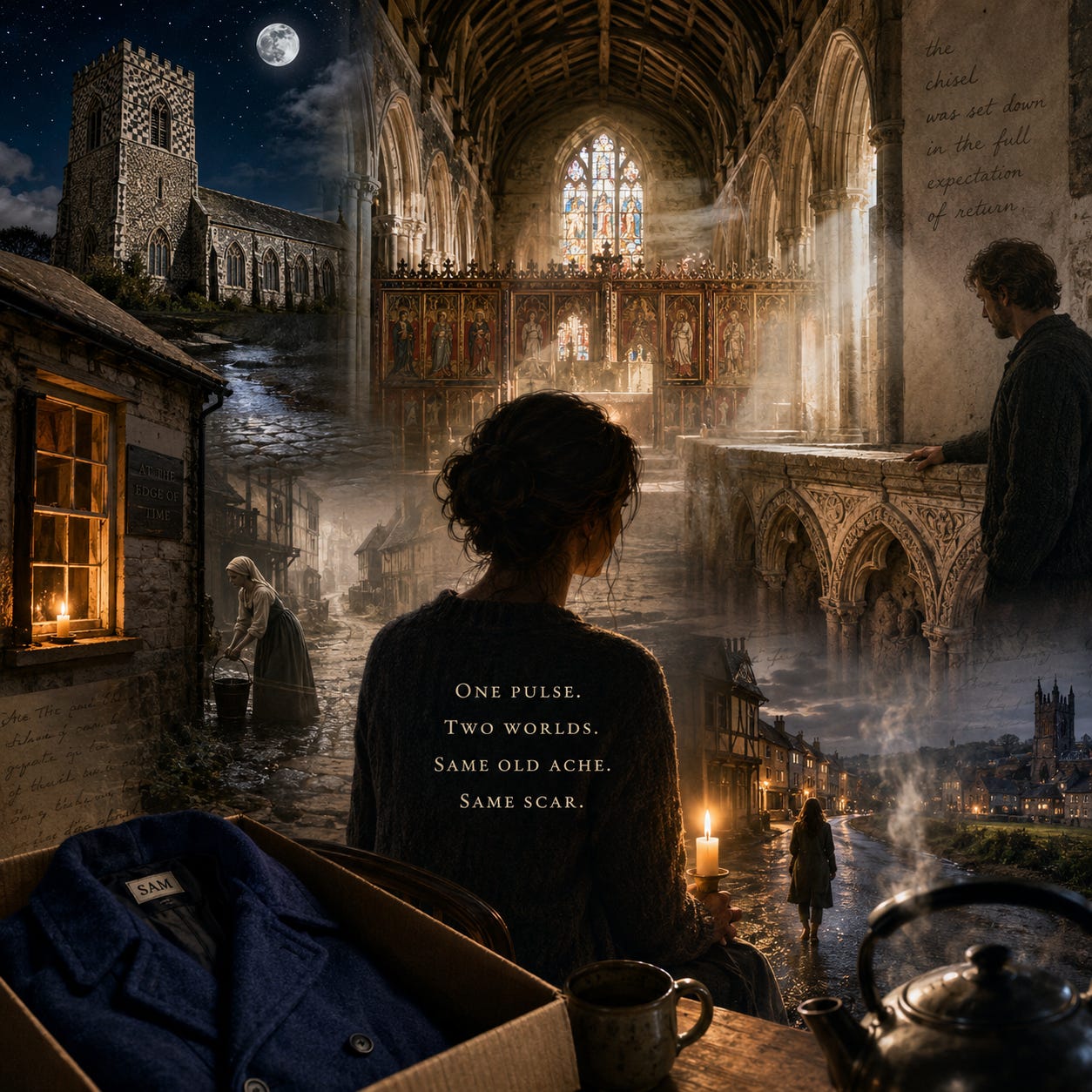
Grief brought Lynden to Kersey. The village had other plans.
In this Suffolk hamlet, where a mason set down his chisel in 1349 and the Black Death prevented him from ever picking it up again, the past is not history — it is sediment, layered and breathing. The coat on the hook. The kettle that boiled before it was switched on.
Sam is gone. But Kersey is a place where time has a fault line, and in the fold between one age and the next, the things we cannot finish — and the people we cannot leave — wait at the edge of completion.
Some thresholds, once crossed, do not require us to come back. Only to choose.
Lynden arrived in Kersey on a Tuesday in November, carrying Sam’s coat in a cardboard box. The cottage was at the end of a lane, past the splash where the stream crossed the road in a shallow ford. She’d chosen it from a photograph: low beams, stone floors, a garden that ran down to water. Somewhere to be alone with what had happened.
The key was under a pot of rosemary. Inside, the air smelled of woodsmoke and old plaster. She set the box on the kitchen table, opened it, lifted the coat, and hung it on the hook by the door. Blue wool. His scent still in the collar. She touched the sleeve once, then went to make tea.
The kettle boiled before she switched it on.
She stared at it. The element was cold. The plug was out of the wall. Yet steam rose from the spout in a thin white thread, and the sound it made was the sound Sam’s kettle had made in their flat — the same pitch, the same shudder. Lynden stood very still. The kettle clicked off. Silence settled over the kitchen like dust.
She did not try to explain it.
That first night she slept badly. The bed was too soft, the sheets too cold. At three in the morning she went downstairs for water and found Sam’s coat hanging in the hall. She had left it in the box. She was certain of this. The blue wool caught the moonlight from the window. She touched the sleeve. The fabric was warm, as if someone had just taken it off.
Lynden carried the coat back to the kitchen, folded it, and placed it in the box. She weighted the lid with a jar of dried pasta. In the morning, the coat was back on the hook.
She stopped trying to move it.
The village revealed itself in layers. Kersey was older than she’d imagined. The main street climbed in a gentle slope, flanked by timber-framed houses that leaned toward each other as if sharing secrets. The church of St Mary stood on the hill above, its tower completed in a different century from its nave — the flint chequerwork of the upper stages newer in character, brighter in cut, as if the stone remembered the interruption between one age of building and the next. She learned, in time, that the tower’s lower courses had been begun in 1335, then abandoned when the Black Death came. Work resumed only in 1481, more than a century later. The masons who finished it had never known the ones who started it. The stone bore both their marks.
Lynden walked the village every morning. She crossed the splash, her boots wet, and climbed toward the church. The path wound between cottages with names carved in oak: The Priory, Weavers, Clovelly. She counted seven arches in the church arcade, each pillar octagonal, each arch pointed in the Decorated style. The north aisle had been built just before the pestilence. The sedilia at the east end — three stone seats with canopied arches — were unfinished. The carving simply stopped, mid-tracery, as if the mason had laid down his chisel and walked away. Not in haste. In the manner of one who expects to return.
She sat in the church for an hour, watching dust motes turn in the light from the east window. The angel roof soared above her, hammer beams carved with figures whose faces had been chiselled away during the Reformation. Headless angels. She understood the impulse. Sometimes you had to remove the thing you couldn’t bear to see.
On the fourth day, she experienced the silence.
She was walking up the main street after rain, the road dark and wet, the stream running high. The church bells had been ringing — the quarter chimes, she thought — but as she passed the Bell Inn, they stopped. Not faded. Stopped. The air went still. No birdsong. No traffic. No sound at all except the trickle of water over stone.
Lynden looked up. The houses had changed. The thatch was gone, replaced by rough timber roofs. The windows were small, unglazed, with shutters drawn. The street was empty. No cars, no telephone wires, no satellite dishes. She could smell woodsmoke and something else — something sweet and rotten, like fruit left too long in the sun.
She walked on. The church tower was lower than it should have been, its flint walls raw, the upper stages not yet raised. She entered through the south porch. Inside, the walls were bare stone, no plaster, no whitewash. The floor was earth, packed hard. The angel roof was gone; above her was only open timber, rough-hewn, the space unclosed. The rood screen stood across the nave, painted in reds and golds, the figures of kings and prophets sharp against the gloom.
Lynden stood in the nave and heard her own breath. Then she heard another sound: a voice, low and known, humming a tune Sam used to hum when he cooked. It came from everywhere and nowhere. The air shifted. The church filled with light — the east window blazing, the angels restored, the floor tiled, the walls painted with saints. She saw Sam, not as a ghost but as a presence, standing by the sedilia, his hand on the unfinished stone.
He looked at her. She looked back. Then the bells began again, and the moment folded.
She was in the modern church. The arcade arches rose in their seven regular rhythms. The rood screen panels stood in the Sampson chapel, the painted St Edmund holding his arrow. The sedilia were empty.
Lynden did not tell anyone what she had seen. She returned to the cottage and found Sam’s coat hanging in the hall. She touched the sleeve. It was damp, as if he’d just come in from the rain.
That evening she lit a candle and set it in the window. She left it burning all night, as she did every night after — a light for the dead, for the living, for the in-between. The floorboards creaked with footsteps that had his particular weight, his particular pace. She did not look up from her book.
In the glass, his face arrived, then broke apart in the candle’s reflection. She stopped trying to hold it.
The days settled into a rhythm. She walked the village in the mornings, sat in the church in the afternoons, and lit the candle at dusk. The time slips came more often — each one a shift in the air, a folding of the light, the world’s seam showing. Once she saw the splash running clear and shallow, the cobbles at the ford replaced by bare earth, a woman in a wimple drawing water with a bucket. Another time she heard the hum of a loom from a cottage that had been converted to holiday lets. The past was not gone. It was layered, like the sedilia’s unfinished carving — a work interrupted but never abandoned.
She began to understand that Kersey was a place where time had a fault line. The Black Death had stopped the mason’s chisel mid-stroke in the north aisle, and in that interruption something had opened — a gap, a fold, a place where grief and love could coexist without resolution. Sam was not dead. He was not alive. He was held, like the stone at the point where the carving stopped, at the edge of a form that had never been completed and so had never been closed.
One evening she stood in the north aisle before the shrine that had been re-hallowed in 2020. The alabaster Trinity group stood in its niche — the Father holding the broken Christ. She touched the cool stone. Behind her, the rood screen panels glowed in the candlelight. She heard Sam’s voice, not humming this time but speaking, though she could not make out the words. The sound was like water over rock — constant, worn smooth, part of the place.
She turned. He was there, by the unfinished sedilia. Not a spectre. Not a memory. A version of him that existed in this fold of time, where the chisel had stopped mid-stroke and the world had held its breath, and the holding had become a kind of permanence.
Lynden did not reach for him. She did not speak. She stood where she was, in the dust and candle glow, and let the moment be.
On her last night in Kersey she walked the village at midnight. The air was cold, the stars sharp above the church tower. She crossed the splash, the water black and moving, and climbed the main street. The houses were dark, their timber frames silvered by moonlight. She heard nothing but her own footsteps and the stream.
At the church she entered through the north porch. The stoup was dry. The nave was empty. She sat in the front pew and waited. The silence came — not the absence of sound but the presence of time, folding around her like the pages of a book read in both directions at once. She saw the church as it was and as it had been — the incomplete tower of 1349 and the finished tower of 1481, both true, both standing in the same stone. The headless angels. The rood screen with its painted kings. The shrine with its broken Christ.
And Sam, by the sedilia. His hand on the stone where the carving stopped.
He looked at her. She looked back. The candle she held flickered, and in its guttering she understood what she had come to understand: that love is not a line with a terminus but a space that holds its shape even after the one who made it has gone. That loss is not an ending but the form absence takes when it decides to stay. She could remain in this fold, where he existed at the edge of completion, or she could return to the world that had continued without him.
She blew out the candle.
The darkness was absolute. Then, slowly, the moonlight came back through the windows, and the church resumed its singular form — its seven arches, its angel roof, its sedilia empty and mid-carved and permanent in their incompletion.
Lynden walked back to the cottage. Sam’s coat hung in the hall. She did not touch it. She left the light burning in the window and went to bed and slept without dreaming.
In the morning she packed her things. She folded the coat and placed it in the box. She drove away from Kersey, past the splash, up the hill, and onto the road that led to the A1141. In the rear-view mirror, the church tower rose against the sky — its lower courses begun in one century, its upper courses finished in another, its whole self the record of an interruption that had not prevented completion, only deferred it.
She did not look back. She did not need to. The coat was in the box. The light was still burning in the window. And somewhere, in the place where the fault line held, Sam stood with his hand on the stone — at the point where the carving stopped, where the chisel had been set down without ceremony, in the full expectation of return.
Listen to my song, the lyrics of which form the bones on which this story is hung